
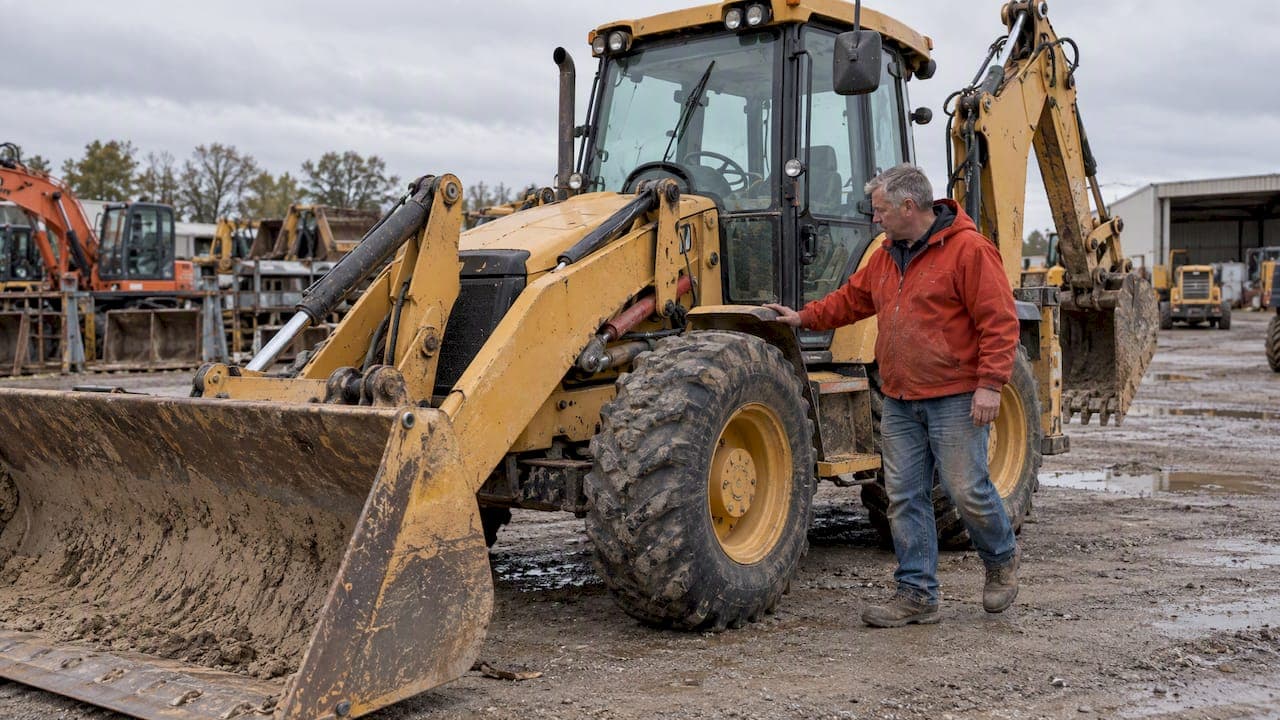
To sell a backhoe online, pick the channel that matches your timeline, price the machine against real transaction data instead of retail asking prices, and publish a listing with honest hours, clear photos and service records. Then confirm payment before the machine leaves your yard and talk to a tax professional about the sale. This guide walks through each step for U.S. sellers, whether you run a contracting company, a rental fleet or a dealership, or you are selling a single machine.
TL;DR
- Choose your channel first: an auction trades price for speed, while a classified listing usually brings a higher asking price and a longer wait.
- Price from recent sales and your machine's condition. The average used backhoe in the U.S. sold for $70,521 between June 2024 and May 2025, but age and hours move that number a long way.
- Documented hours, maintenance records and a clean hydraulic system do more to close a sale than any wording in the ad.
- If the backhoe was expensed or depreciated, part of the gain can be taxed as ordinary income. Check Form 4797 with your accountant before you agree on a price.
Table of Contents
- Pick the sales channel before you price the machine
- Set a price buyers will actually pay
- Prepare the backhoe so it sells itself
- Write a backhoe listing that earns calls
- Screen buyers and protect the payment
- Count the tax before you accept the offer
- Our view: sell on condition and clarity, not on hype
- List your backhoe where equipment buyers shop
- FAQ
- Sources
Pick the sales channel before you price the machine
The channel decides how you price, how long you wait and what you pay in fees. Most backhoe sellers choose from four routes.
| Route | Speed | Typical price outcome | Effort for you |
|---|---|---|---|
| Online auction | Fast, fixed sale date | Lowest, after buyer premiums and transport are counted | Low |
| Direct sale to a buyer or trade-in | Fast | Below market, in exchange for convenience | Low |
| Dealer consignment | Medium | Close to market, minus the dealer's cut | Medium |
| Online classified listing | Slowest, often weeks | Highest asking price | High: you field calls and inspections |
Industry reporting makes the same split. Auctions give immediate liquidity to a seller who wants out quickly. Private resale and listing sites allow higher asking prices but take longer, because you have to find a buyer and host inspections. Sellers often assume an auction result equals retail value, then are disappointed once fees and logistics come off.
If the backhoe is idle and costing you insurance, storage and depreciation, a few extra weeks on a classified listing is usually worth the higher price. If you need cash this month, an auction or a direct sale is the honest answer. Our guide to selling heavy equipment fast without leaving money on the table compares these routes in more detail, and the same trade-off appears when you sell a skid steer online.
Set a price buyers will actually pay
Overpricing is the most common reason a backhoe sits unsold. Sellers look at other people's asking prices. Buyers, especially contractors and dealers, look at what machines really sold for.
Start with market data
Three data points frame the current market:
- Average price and age. EquipmentWatch data reported by Equipment World puts the average used backhoe price at $70,521 for the 12 months ending May 31, 2025. The average age of units traded rose from 8.3 to 9 years.
- Tight supply. In September 2025, the used loader backhoe category showed a 19.73% year-over-year drop in inventory, while auction values rose 1.99%. Fewer machines for sale helps a seller with a clean unit.
- Firm values. A mid-2025 auction report found loader backhoe asking values up 2.7% month over month and auction values up 2.26%, a sign of resilience for well-maintained machines.
Treat these as context, not a quote. They are national averages from 2025. Check the latest figures for your own make, model year and region before you settle on a number.
Adjust for your machine
The $70,521 average covers machines of very different ages. Move up or down from it using these factors:
- Hours and age. Compare your meter reading with similar machines. A unit well below the average age of nine years commands a premium.
- Make and model. Case, Caterpillar, John Deere and JCB machines have deep parts and service networks, which buyers value.
- Configuration. 4x4, extendable dipper, hydraulic quick coupler, auxiliary hydraulics and a ride-control option all matter to a working buyer.
- Condition of wear items. Tires, bucket teeth, pins and bushings, and stabilizer pads signal how hard the machine worked.
- Repair exposure. Buyers are wary of expensive hydraulic and powertrain repairs. A machine with a documented recent pump, cylinder or transmission service is easier to price high.
Leave room for negotiation, but not too much
Price the machine where you would be happy to land after a modest negotiation, not 30% above it. Professional buyers know the gap between asking and realized prices can be wide, and a number that looks inflated gets skipped rather than countered. Set a firm floor in your head before the first call. If the machine has had no serious inquiry after two or three weeks, the price is the first thing to revisit, not the photos.
Prepare the backhoe so it sells itself
A buyer who cannot verify condition from the listing will assume the worst. The research is consistent: accurate condition reporting and maintenance history are what separate machines that sell well from machines that linger.
Gather the paperwork
- Title or certificate of origin, and proof that no lien remains. If a lender holds a lien, arrange the payoff before the sale.
- Service records: oil and filter changes, hydraulic fluid and filter changes, transmission service, major repairs with invoices.
- Serial number, model year and current meter reading. Take a photo of the hour meter.
- Any manuals, spare keys, extra buckets or attachments you are including.
Service and clean it
Wash the machine, including the undercarriage of the loader frame and around the stabilizers, so leaks are visible rather than hidden under grime. Fix small items that raise doubts: a cracked light lens, a missing pin, a worn seat. Grease every fitting and top off fluids. Do not paint over damage or steam-clean away an active leak. A serious buyer will find it, and you lose trust.

Run a self-inspection
Operate the machine as a buyer would, and note what you find so you can disclose it:
- Cycle the loader and the backhoe through full range. Watch for jerky movement, slow response or drift.
- Check cylinders, hoses and fittings for seepage.
- Test every gear in forward and reverse for slipping or grinding.
- Inspect the frame, boom, dipper and bucket for cracks or repaired welds.
- Measure tire tread and check for cracks or uneven wear.
- Start it cold and note smoke, noise and warning lights.
If the machine needs work, decide whether to repair it or price the repair in. Price it in when the cost is unclear. Repair it when the fix is cheap and visible.
Write a backhoe listing that earns calls
A strong listing answers the questions a buyer would otherwise ask by phone. That saves you time and screens out people who are not serious.
Photos
Shoot in daylight on level ground, and take more shots than you think you need. Our guides on selling an excavator fast and selling a tractor online recommend a set of clear photos, and the same logic applies here. For a backhoe, cover:
- All four sides and both ends of the machine
- The cab interior and the hour meter
- The loader bucket and the backhoe bucket, showing teeth and cutting edge
- Stabilizers, pins and bushings
- Tires, all four
- The engine bay, the serial number plate and any damage, close up
A short walk-around video with the engine running and the hydraulics cycling tells a buyer more than a paragraph of text.
Specification block
Put the facts in a scannable list at the top of the description:
- Year, make, model and serial number
- Hours (state if the meter was replaced)
- 2WD or 4WD, transmission type (powershift or powershuttle)
- Digging depth, extendable dipper, bucket sizes
- Attachments and quick coupler
- Tire condition
- Last major service date
- Location (city and state) and whether you can help with loading
Honest description
Say what is right and what is not. "Hydraulic leak at the stabilizer cylinder, seals needed" costs you a little on price and saves you a dispute at pickup. Buyers forgive disclosed flaws. They do not forgive discovered ones.
Finish with how to reach you and when you are available for inspections.
Screen buyers and protect the payment
Most backhoe sales fall apart at the end, not the beginning. Build a process that protects you.
- Qualify the buyer. Ask what the machine is for, where it is going and how they plan to pay. A real buyer answers easily.
- Host inspections on your terms. Schedule by appointment, at your yard, with you present. Allow a third-party mechanic if the buyer wants one.
- Be wary of the classic scams. Overpayment with a request to refund the difference, a buyer who will not speak by phone, a "shipper" who wants fees up front, and a check that clears slowly. Our seller checklist for selling an excavator online goes through the red flags, and they are identical for backhoes.
- Take safe payment. For a machine of this value, use a bank wire confirmed by your own bank, or an escrow service. Do not release the machine against a personal check or a payment screenshot.
- Sign a bill of sale. Include both parties, the serial number, the price, the as-is condition and the date. Sign the title over only when funds have cleared.
- Plan transport. Most out-of-state buyers hire a hauler. Agree in writing who arranges and pays for it, and who is responsible during loading. Our guide to selling a wheel loader online covers what a rushed trade-in costs you and why shipping details matter to the final number.
Count the tax before you accept the offer
If the backhoe belongs to a business, the sale price is not the same as your profit. Tax treatment is where "top dollar" can turn into a disappointing net.
Business sales of equipment are reported on IRS Form 4797, the form for sales of business property. If you expensed the machine under Section 179 or depreciated it, selling above your adjusted basis can trigger depreciation recapture, which is generally taxed as ordinary income rather than as a capital gain.
Here is a simple illustration with made-up round numbers, not a prediction: you bought a backhoe and fully expensed it, so your adjusted basis is $0. You sell it for $50,000. The entire $50,000 may be treated as recapture rather than a lower-rate gain. That changes how you compare an auction offer with a slower, higher listing price.
Talk to your CPA before you commit to a price, particularly if the machine was bought with Section 179 or bonus depreciation, if you are trading in rather than selling outright, or if you are selling several machines in one year. Our article on Section 1245 recapture for equipment sellers explains the mechanics, and the piece on selling a dump truck and Form 4797 shows how the same form applies to a truck sale.

Our view: sell on condition and clarity, not on hype
We run a marketplace built for commercial and industrial equipment, and we see the same pattern in what sells. The sellers who do well treat the listing as a spec sheet for a professional buyer. They state the hours, show the machine honestly and answer inquiries quickly.
We also advise sellers to decide their priority up front. If speed matters most, accept a lower number from an auction or a direct buyer. If price matters most, list the machine where equipment buyers already look, and give it the time a good listing needs. Mixing the two goals is where sellers get frustrated: they list high, panic after three weeks and take a lowball offer.
Finally, ask your accountant about the tax before you negotiate. A backhoe that nets less after recapture may still be worth selling now, but you should decide that knowingly.
— Dave
List your backhoe where equipment buyers shop
Sostruckforsale is an online marketplace where dealers and private sellers post classified ads for commercial vehicles and industrial equipment. Listings are organized by category, subcategory, price and country, so a buyer searching construction equipment can find your backhoe without wading through unrelated ads. Dealers can also register in the business directory. Browse the Construction Equipment category and our other equipment categories to see how listings are presented, then post yours.
FAQ
How do I sell a backhoe?
Gather the title, service records and serial number, clean and inspect the machine, and price it against recent sales. Then post a listing with a full photo set, honest hours and a specification list on a marketplace that equipment buyers use. Verify payment before releasing the machine.
How much is a used backhoe worth?
The 12-month average for used backhoes in the U.S. was $70,521 through May 2025, at an average age of 9 years. Your machine can be worth much less or more depending on hours, make, configuration and repair history, so compare it with similar units that actually sold.
What is the best website to sell machinery?
It depends on your goal. Auctions suit sellers who need a quick exit, and classified marketplaces suit sellers who want a higher price and can wait for the right buyer. Choose a site with a category for your machine type and an audience of equipment professionals, then compare fees before you post.
Do I owe tax when I sell a backhoe I use in my business?
Possibly. If you depreciated or expensed the machine, the sale may trigger depreciation recapture, reported on Form 4797. Ask a CPA to estimate the result before you accept an offer, because it can change which offer is best.
Sources
- Top-Selling Backhoe Loaders for 2024-2025, Equipment World
- September 2025 Market Report, NEFA
- June 2025 Auction Trends, CompactEquip
- Instructions for Form 4797, IRS
- Depreciation and recapture, IRS