
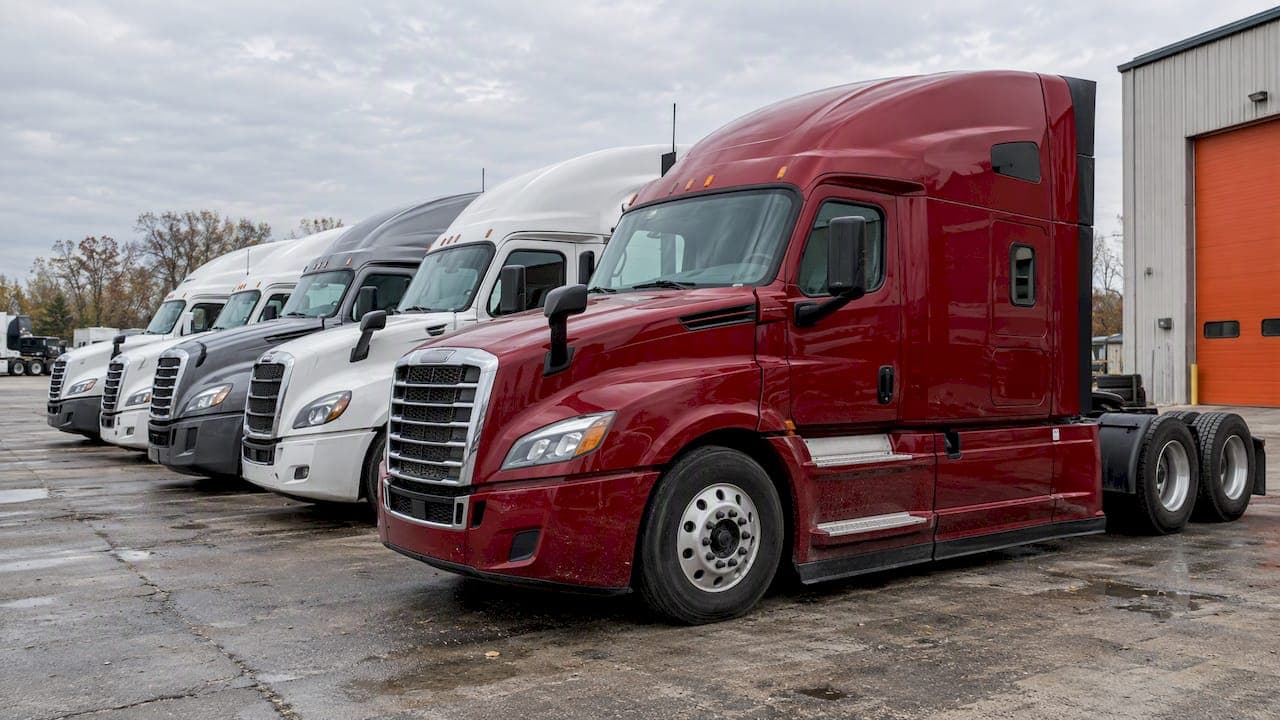
To sell multiple trucks well, treat the batch as separate trucks that happen to be sold together. Split the units by how they should be sold, build a record packet for each VIN, price every truck on its own facts, and keep your USDOT number and tax paperwork out of the buyer's deal. Buyers pay for evidence and clarity. They do not pay a premium for volume.
This guide is for dealers, fleet owners and machinery sellers in the U.S. who have three, ten or fifty trucks to move. It covers channels, records, pricing, grouping, listing quality and the compliance points that trip up fleet sales.
TL;DR
- Sort units into retail-ready trucks and aging or hard-to-finance trucks. Sell each group through the channel that fits it.
- Build one packet per truck: VIN, title and lien status, maintenance history, mileage evidence, specs, location, asking price and delivery terms.
- Do not use one bulk price. Late-model trucks with similar specs have closed at very different prices, so price unit by unit and reprice often.
- A truck sale does not transfer your USDOT number or MC authority, and a fleet sale can trigger Form 4797 reporting and depreciation recapture. Plan both before you accept offers.
- Group listings by buyer use case, and publish finance-relevant facts up front.
Table of Contents
- Decide how each truck should be sold
- Build a sale packet for every truck
- Price each truck on its own facts
- Group trucks by buyer use case
- Keep your USDOT number out of the sale
- Plan the tax side before you accept offers
- Our view: sell the evidence, not the count
- List your trucks where buyers are looking
- Run the batch from first inquiry to closing
- FAQ
- Sources
Decide how each truck should be sold
The first decision is channel, and it is made truck by truck. An August 2026 Equipment Finance News report on dealers offloading trucks describes a mixed approach: retail listings for financeable, well-documented units, and auctions or cash buyers for aging inventory. The same report says all surveyed truck dealers saw steady or improving demand in July 2026, and nearly 80% saw improving demand. Demand is there, but lending standards are still tight, which is why the sorting matters.
A simple three-bucket sort works for most sellers:
| Bucket | Typical unit | Best channel |
|---|---|---|
| Retail-ready | Newer model year, clean records, clear title, financeable | Public classified listing with full specs and photos |
| Middle | Solid truck, some gaps in records or higher miles | Classified listing priced to the gaps, direct outreach to known buyers |
| Aged or difficult | Old, high-mileage, missing history or hard to finance | Auction or cash buyer |
Do not force every unit into the same channel. A truck that would sit unsold on a retail listing for months can drag the whole batch down if you bundle it with your best units. A truck with a spotless history sold at auction leaves money on the table.
If you want a deeper look at the mistakes sellers make at this stage, our guide to common semi truck resale mistakes walks through them.
Build a sale packet for every truck
A multi-unit deal stalls when one truck has a missing document. The fix is to prepare each truck as if it were the only one for sale. For every unit, gather:
- VIN or serial number, plus your internal unit number
- Title and lien status, including any payoff letter you will need
- Inspection, repair and maintenance history
- Mileage and engine-hour evidence
- Full specifications: make, model, year, engine, transmission, axle configuration, tire size
- Current location
- Asking price
- Delivery or pickup terms
This is not busywork. The FMCSA Motor Carrier Safety Planner says carriers must keep maintenance records that identify each vehicle, along with records of inspections, repairs and maintenance. It also sets retention periods: one year where the vehicle is housed or maintained, and six months after the vehicle leaves the carrier's control. If you are a carrier selling units, you probably already hold much of what a buyer will ask for. Index it by VIN so you can send the right file in minutes.
Document mileage from more than one source
Dashboard mileage alone invites doubt. FMCSA's ELD technical FAQ says an ELD must display the ECM odometer value when it differs from the dashboard, and that engine-change documentation must be kept. For each listing, state the odometer source, any engine replacement, engine hours where relevant, and attach the supporting records. Buyers and fleet managers who want to know what to look for can read about odometer fraud prepurchase checks. Showing your evidence before they ask removes the objection.
Publish finance-relevant facts first
IronAdvisor research director Jarrett Harris said in the same August 2026 report that financing remains hard for smaller fleets with credit blemishes, and that dealers may have to shop multiple financing venues or structure creative deals. For a seller, the practical lesson is to put age, mileage, maintenance history, title status and price in the listing itself. A lender can then evaluate each truck quickly, and the buyer finds out early whether the batch is fundable.
Price each truck on its own facts
One bulk price is the most common way to lose money on a fleet sale. Auction results show why. In February 2025 auction reporting, several 2024 Freightliner Cascadia sleepers sold for more than $140,000, while three 2024 International sleepers with fewer than 5,000 miles sold for nearly $120,000. Kenworth and Peterbilt trucks from 2024 with more than 130,000 miles sold for a little over $100,000.

The spread continues in older units. Reported closing bids for 2021 to 2023 heavy-duty trucks ranged from about $22,000 to $85,000, with one 2022 Peterbilt at $100,000. Models from 2012 to 2019 mostly sold between $9,000 and $20,000. Trucks of the same age and make landed in very different places, driven by mileage, spec and condition.
A workable pricing routine:
- Set two benchmarks per unit. One is a retail asking price. The other is the likely auction or cash-buyer number. The gap between them tells you how much patience a unit is worth.
- Price to the condition, not the average. A low-mileage unit with full records should not be priced like the one next to it that has gaps.
- Reprice on a schedule. Used heavy-duty truck markets have moved quickly in both directions, so review asking prices every few weeks rather than leaving a batch static.
- Offer a package discount only after you have unit prices. If a buyer wants five trucks, you can then negotiate from a position of known numbers.
For a primer on setting numbers that buyers act on, see this guide to pricing used items to sell. For tractor ranges, our semi truck pricing guide covers $45K to $220K budget bands for 2026.
Group trucks by buyer use case
An undifferentiated block of trucks asks the buyer to do the sorting. Do it for them. In a March 2025 report on reducing dealer inventory, Ram Professional's Dave Sowers explained that more product-line complexity makes inventory harder to manage, because dealers must balance variety against floorplan, lot-management and other holding costs. For a multi-truck campaign, that points to grouping units by who will buy them.
Useful groups include:
- Regional haul sleepers for small fleets and owner-operators
- Day cabs for local and drayage work
- Dump and vocational trucks for contractors
- Service and pickup units for utility and trade businesses
- Trailers sold as a matched set or individually
Each group gets its own listing headline, its own lead photo and its own price logic. A contractor looking for a dump truck should not have to scroll through sleepers. If you sell dump trucks, our guide for fleet buyers on shortlisting dump truck sites shows how they search, which helps you write listings they will find.
Presentation counts at this stage too. A clean, detailed truck photographs better and sells faster, so it helps to read how a detailer approaches a Ford F250 Lariat before your photo day. Then shoot every unit to the same standard. Our checklist of 12 to 15 auction-grade listing photos covers the angles buyers expect.
Keep your USDOT number out of the sale
If you are a carrier selling trucks, make the agreement say that the buyer is purchasing equipment and records. It is not purchasing your registrations. FMCSA's answer on selling a USDOT or MC number says a USDOT number belongs to the assigned legal person and may not be sold or leased for use by another party. It also warns against buying or leasing a number or operating authority from an unknown person outside a legitimate corporate transaction.
There is one nuance. In a real corporate transaction, FMCSA says the number can stay with a corporation that continues as the same legal person, while a new or surviving entity may need its own. That is a question for your counsel, not something to settle in a bill of sale. Unless counsel confirms a legitimate entity transaction, the agreement should identify each truck by VIN and exclude your registrations. A buyer acquiring only assets generally needs its own registration and operating compliance.
Plan the tax side before you accept offers
A fleet sale creates accounting work that is easy to miss until after closing. The IRS instructions for Form 4797 state that sales of depreciable tangible trade or business property are reported on that form. Depreciation, amortization and Section 179 deductions can enter the recapture calculation. The result depends on each truck's adjusted basis, holding period, the depreciation claimed or allowable, and whether the unit is inventory or business-use equipment.
Before you take offers, build an asset schedule with one row per truck: purchase date, cost, depreciation taken, adjusted basis and target price. Then your tax professional can model outcomes for each deal structure. Selling a truck above its adjusted basis can produce ordinary income through recapture, so the net you keep may differ from the headline price. Our articles on Section 1245 recapture for equipment sellers and selling a dump truck online and Form 4797 explain the mechanics. Confirm your specific situation with a CPA before signing.
Our view: sell the evidence, not the count
We run a marketplace for commercial vehicles and industrial equipment, and listing pages are what we see all day. Here is what we would tell a seller with a batch of trucks.
The number of trucks is the least interesting thing about your offer. A buyer scanning a listing is asking whether this truck is what you say it is. Sellers who answer that with a VIN, a mileage source, a service history and honest photos get serious inquiries. Sellers who post a block of units with a round number and a phone line get low offers and tire-kickers.

We built the platform for industry professionals. It offers a dedicated classified environment for commercial and industrial equipment, multi-category coverage and dealer registration options. For a multi-truck sale that means you can list each unit with its own category, subcategory, price and country filter, so buyers find the one truck that fits them rather than a vague lot.
Our advice is plain. Keep a separate listing per truck. Group by use case. Reprice on a schedule. Keep your paperwork clean. If you manage a larger stock, also set up your feed and inventory process properly: our guides to inventory feed setup and managing dealer inventory on a platform cover that.
— Dave
List your trucks where buyers are looking
Once your packets, prices and groups are ready, you need a place to publish them. Sostruckforsale is an online marketplace where dealers and private sellers post commercial vehicles and heavy equipment: trucks and trailers, construction equipment, material handling, agriculture, forestry and grounds care. Listings can be filtered by category, subcategory, price and country, and dealers can register for the business directory. Post each truck as its own ad and let buyers compare them against the rest of the market.
Run the batch from first inquiry to closing
Once listings are live, a routine keeps the sale moving.
- Answer fast with the right file. Because each truck has a VIN-indexed packet, you can send documents within minutes of an inquiry.
- Qualify the buyer's financing early. Ask how the buyer plans to fund the purchase, and share the finance-relevant facts you already published.
- Offer inspection access. Let the buyer or a third-party inspector see the truck, and be clear about where it sits.
- Write one agreement with a unit schedule. Even when a buyer takes several trucks, list each by VIN with its own price and condition notes.
- State what is excluded. Name your USDOT and MC numbers as not included, and note any aftermarket equipment or telematics hardware that stays or goes.
- Settle title and lien releases truck by truck. Do not release any unit until its payment has cleared and its lien is resolved.
- Agree delivery terms. Say who arranges and pays for transport, and when risk passes.
Sellers who want more best practice on running a dealership around this process can read our commercial truck dealer best practices for 2026. If you are weighing where to advertise, our overview of commercial vehicle classifieds and fleet mistakes to avoid is a good place to compare approaches.
FAQ
Should I sell all my trucks to one buyer or list them separately?
List them separately first, then take a package offer if one comes in. Separate listings let each truck find its best-fit buyer and give you unit-level prices to negotiate from. A single buyer for the whole batch usually expects a discount, and you can only judge that discount if you know what each truck is worth on its own.
What documents do I need to sell several commercial trucks?
Prepare a packet per truck with the VIN or serial number, title and lien status, inspection and repair history, maintenance schedule, mileage and engine-hour evidence, specifications, location, asking price and delivery terms. If you operate as a carrier, FMCSA expects vehicle maintenance records to carry identifying information and to be retained for set periods. Index everything by VIN.
Does the buyer get my USDOT number when I sell my trucks?
No. FMCSA says a USDOT number belongs to the assigned legal person and may not be sold or leased for use by another party. Your sale agreement should cover the equipment and records only. If you are selling the business itself, ask your attorney how the transaction affects registrations.
How are taxes handled when I sell multiple trucks?
For U.S. business sellers, sales of depreciable business property are generally reported on IRS Form 4797, and depreciation or Section 179 deductions can create recapture. The outcome depends on each truck's adjusted basis, holding period and whether it is inventory or business-use equipment. Build an asset schedule and consult your tax professional before you close.
Sources
- Dealers offloading trucks in spite of tight lending climate, Equipment Finance News
- Used-truck auction highlights late-model pricing gaps, Equipment Finance News
- Ram Pro, Mercedes helping dealers reduce inventory, Equipment Finance News
- The Motor Carrier Safety Planner, FMCSA
- ELD FAQ, FMCSA
- Can I sell my USDOT# or MC#, FMCSA
- Instructions for Form 4797 (2025), IRS