
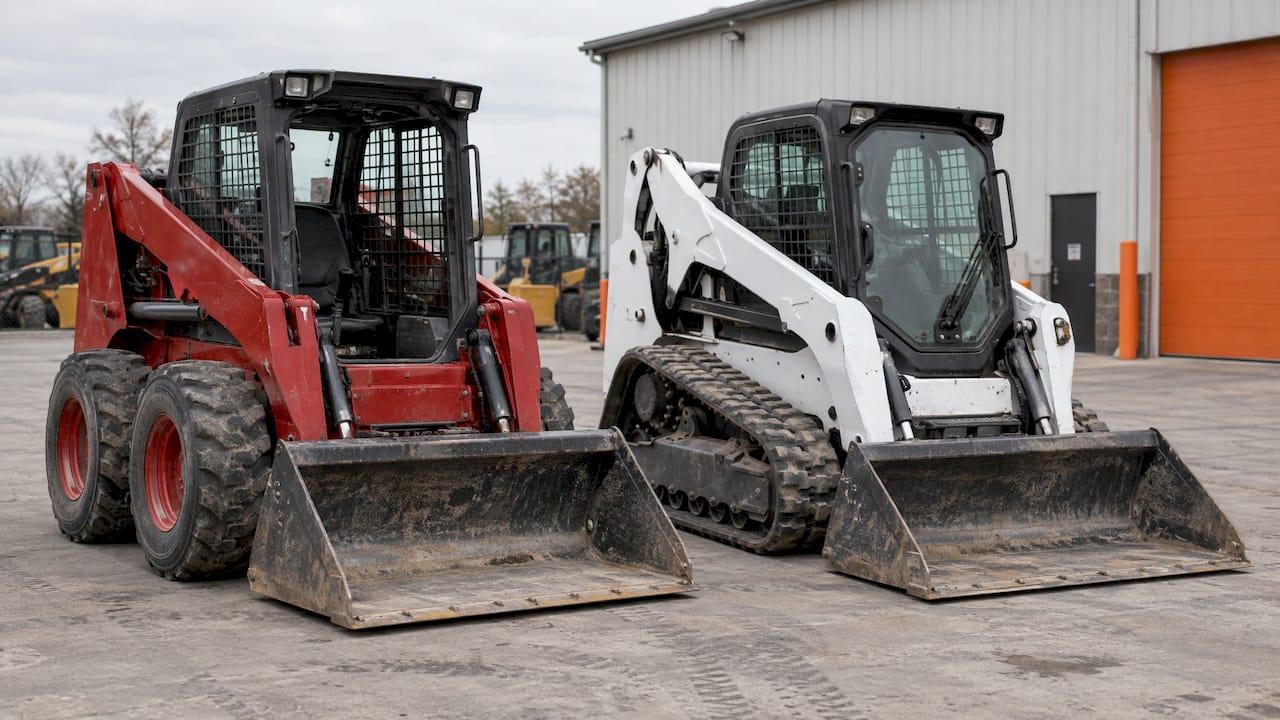
A skid steer rides on four tires. A compact track loader (CTL) rides on two rubber tracks. That one difference in the undercarriage sets ground pressure, traction, purchase price, upkeep and the jobs each machine suits, according to Bobcat's U.S. buyer's guide. For a dealer, that means buyers do not search for "a loader." They search for the machine that fits their ground, and a listing that answers the ground question sells faster. Our dealer listing environment on Sostruckforsale is built for exactly this kind of equipment, with category, subcategory, price and country filters.
TL;DR
- Tires versus tracks decides everything else: ground pressure, traction, speed, purchase price, wear costs and transport weight.
- Skid steers suit firm, paved or compacted ground, fast cycles and lower cost. CTLs suit soft, muddy, sloped or turf-sensitive sites and heavy digging.
- Rated operating capacity (ROC) is calculated differently: 50% of tipping load for skid steers, 35% for CTLs, so same-class machines are not directly comparable.
- Hydraulic flow and attachment compatibility are the next questions buyers ask. Put them in the first lines of every listing.
- State the undercarriage, hours and track or tire condition plainly. Those fields move the price and the buyer's confidence.
Table of Contents
- The core difference: tires or tracks
- Ground conditions decide the purchase
- Cost: purchase, operation and wear parts
- Capacity: why ROC is not apples to apples
- Hydraulics and attachments
- Transport and jobsite access
- How buyers actually decide
- How to list each machine so it gets found
- Perspective
- Put your loaders in front of equipment buyers
- FAQ
- Sources
The core difference: tires or tracks
Both machines are compact, maneuverable loaders used for digging, lifting and material handling. Both take a wide range of attachments and are common in construction, landscaping and agriculture, and both are offered with diesel or battery power. The skid steer's four-wheel base and independent side steering let it pivot and counter-rotate in tight spaces. The CTL swaps the tires for tracks and gives up some of that quickness for stability on poor ground.
That is the whole comparison in one sentence. The rest of this guide covers how it plays out in use and how to carry it into your listings.
Ground conditions decide the purchase
Caterpillar says compact track loaders are preferred for soft, muddy or uneven terrain and are well suited to grading, land management and site preparation. Skid steers, with higher ground speed and maneuverability on hard or paved surfaces, are common in road construction, snow removal and utility work.
Bobcat puts the same split in terms of surfaces. CTL rubber tracks give lower ground pressure and more flotation, which limits damage on sensitive surfaces. Skid steer tires suit streets, sidewalks, parking lots and driveways. CTLs give better traction on uneven, soft, sandy or muddy terrain, while skid steers handle snow well and suit concrete and asphalt work where speed matters.

Ground pressure in practice
Ground pressure is the weight on each square inch of contact. Tires concentrate the machine's weight on four small patches. Tracks spread it. On a finished lawn, a wet pad or recently disturbed fill, that is the difference between a clean pass and ruts. Buyers who manage land know this well, and the same logic applies to preventing soil compaction on properties where heavy equipment works repeatedly.
For your listings, this means the buyer's first filter is not horsepower. It is where the machine will work.
A quick field guide
| Buyer's main work | Typical fit | Why |
|---|---|---|
| Paved lots, driveways, concrete, indoor or tight-space work | Skid steer | Faster travel, easier turning, gentler on finished surfaces |
| Snow removal on hard surfaces | Skid steer | Higher ground speed, good snow handling |
| Mud, sand, wet clay, soft fill | CTL | Lower ground pressure, better traction and flotation |
| Slopes and grading | CTL | Stability and grip on uneven ground |
| Finished turf and landscaping | CTL | Less ground disturbance |
| Heavy digging and large lifts | CTL | Stable platform for heavy loads |
This table follows the guidance in Bobcat's comparison guide, which assigns skid steers to firm, stable ground, tight conditions, faster short jobs and easier transport, and CTLs to soft, muddy, snowy or uneven sites, steep slopes, delicate turf and heavy digging.
Cost: purchase, operation and wear parts
Bobcat states that a new skid steer typically costs less than a comparable CTL, and that its routine maintenance is simpler because changing tires is easier and less frequent than servicing a track undercarriage. Skid steers are also lighter and burn a little less fuel. Caterpillar's tracks-versus-wheels page makes the same trade: tracked machines offer enhanced lifting capacity but typically cost more to own and operate, while wheeled machines have lower operating cost where the ground is firm.
What that means for a buyer:
- Skid steer: lower entry price, tire replacement that is periodic but cheaper than track work, and routine checks centered on tire pressure and punctures.
- CTL: higher entry price, regular track tension checks, undercarriage cleaning and attention to idlers, rollers and sprockets, with wear that comes faster in harsh conditions.
Buyers often compare total cost of ownership, not just the ask. For a dealer, that means the wear condition is a price driver. A CTL with a fresh undercarriage and a skid steer with new tires each have a concrete selling point, and a vague description wastes it. Our guide on heavy equipment pricing with auction comps shows how buyers cross-check an asking price, which is worth knowing before you set yours.
Capacity: why ROC is not apples to apples
Rated operating capacity is the maximum weight a machine should lift and carry. Bobcat explains that it is calculated as 35% of tipping load for compact track loaders and 50% of tipping load for skid steers. Two machines in the same size class can therefore carry different ROC numbers.
A buyer comparing a 2,000 lb skid steer with a 2,000 lb CTL may assume equal capability. A well-written listing helps by stating the ROC, the tipping load if known, and the lift-arm type (radial or vertical).
CASE advises buyers to choose a machine whose ROC exceeds the heaviest common lifting task. Its example: if the heaviest pallet is 2,000 pounds, look at a machine with a 2,100 to 2,500 lb ROC. It also notes that hardscape pallets of pavers, retaining wall block or fieldstone can weigh from 1,000 to more than 3,000 pounds.
Construction Equipment notes that skid steers up to 2,200 lb ROC at 50% tipping load are more capable than mini loaders, faster than compact track loaders, and lower in acquisition and operating cost. That is a useful size reference when you categorize smaller units.

Hydraulics and attachments
After ground and capacity, buyers ask what the machine will run. CASE's guide sorts auxiliary hydraulics into three bands:
- Standard flow, 17.5 to 24.2 gpm: buckets, hammers, augers, trenchers and grapples.
- High flow, 30.7 to 41.6 gpm: cold planers, snow blowers, rock saws and mulchers.
- Enhanced high flow, up to 4,100 psi: larger attachments.
A buyer who plans to mulch needs high flow. A buyer who only needs buckets and forks does not need to pay for it. If your machine has high flow, say so in the title or first line. Add the coupler type and whether it has electrical connections for attachment control. Our attachment specs guide covers seven specs contractors check before buying attachments, and listing them alongside the machine saves a round of questions.
Bobcat notes that attachment compatibility is broad on both machine types, so the attachment is rarely the reason to choose one over the other. Hydraulic flow is.
Transport and jobsite access
Skid steers weigh less than comparable CTLs, which makes them easier to move between sites. Equipment World, cited by CASE, adds that a skid steer's higher ground clearance and lighter weight make it easier to trailer. If a buyer is shipping across state lines, weight matters for the trailer and tow vehicle. Our comparison of flatbed and step deck trailers helps you describe what fits your equipment.
How buyers actually decide
Most buyers do not weigh every spec. They run a short mental test:
- Where does the machine work most of the time? Hard, level ground points to a skid steer. Soft ground, slopes or turf protection point to a CTL.
- What is the heaviest regular load? That sets the ROC floor, with the 35% versus 50% rule in mind.
- Which attachments will run? That sets the hydraulic flow.
- What is the budget, including wear? That sets new versus used and which undercarriage condition is acceptable.
- Can it be moved and used where it needs to be? That sets the size and weight.
Industry rules of thumb exist, such as buying for the surface that makes up most of the workload, usually put at around 70% of operating time. Treat them as a starting point, and let the buyer's own ground decide.
Mini machines follow the same logic at smaller scale. Wheeled minis suit hard, tight, high-frequency work. Tracked minis suit mud, soft ground and slopes. Write the tire or track type in the title so buyers filtering for either do not miss you.
How to list each machine so it gets found
The comparison above is the content your listings should carry. A dealer who treats the listing as a spec sheet for the buyer's decision shortens the inquiry cycle.
For a skid steer listing
- Tire type and tread remaining, and whether they are pneumatic or solid.
- ROC at 50% tipping load, lift-arm type and operating weight.
- Hours, hydraulic flow (standard or high) and coupler condition.
- Best-fit surfaces: paved, compacted, concrete, snow, tight sites.
For a compact track loader listing
- Track type and condition, plus undercarriage wear: rollers, idlers and sprockets.
- ROC at 35% tipping load, and say so, so buyers can compare correctly.
- Hours, hydraulic flow and cab features such as enclosed cab and climate control.
- Best-fit surfaces: mud, sand, soft ground, slopes, turf.
For both
- Clear photos of the undercarriage, tires or tracks, cab, hydraulic couplers and hour meter.
- Attachments included, with their specs.
- Location, because buyers in the United States often filter by country and region, and delivery planning depends on it.
A buyer also wants to know the machine is safe to run. Our skid steer inspection guide gives a quick pre-use check to prevent rollovers, and it is a useful model for the condition notes you publish. If you are choosing between a marketplace and a dealer sale route, selling a skid steer online walks through both. For categories beyond loaders, choosing the right equipment category helps you file each unit where buyers look.
Perspective
Dealers often ask whether to list skid steers and CTLs together or separately. Our answer is to list each one by the question the buyer is really asking: what is the ground like?
A buyer with a muddy yard and a buyer with a paved lot can type the same search and need opposite machines. When your title names the undercarriage and your description names the surfaces it suits, the right buyer recognizes the unit in seconds.
That is how we built Sostruckforsale. It is a classified environment designed for industry professionals, with multi-category coverage, dealer registration and filters for category, subcategory, price and country. Skid steers and track loaders sit side by side, so a buyer comparing both finds both of your units in one search.
Put the undercarriage, the ROC basis and the hydraulic flow up front, and let the platform do the sorting.
Dave
Put your loaders in front of equipment buyers
If you carry skid steers, compact track loaders or the attachments and trailers that go with them, Sostruckforsale lets dealers and private sellers post classified ads across construction equipment, trucks and trailers, material handling, agriculture, forestry and grounds care. A business dealer directory is part of the site, and promoted listings are available for units you want to push.
Register as a dealer, add your loader with the specs above, and buyers filtering by category and country can find it.
FAQ
Is a compact track loader better than a skid steer?
Neither is better in general. A CTL is the stronger choice on soft, muddy, sloped or turf-sensitive ground and for heavy digging. A skid steer is the stronger choice on firm or paved surfaces, where its speed, lower purchase price and lighter weight pay off.
Which costs more to own?
Tracked machines typically cost more to buy and to operate, according to Caterpillar, and Bobcat says a new skid steer usually costs less than a comparable CTL. Track and undercarriage wear is the main added cost on a CTL, while tires are the wear item on a skid steer.
Why do two loaders with the same ROC differ in capability?
ROC is 50% of tipping load on skid steers and 35% on CTLs, per Bobcat. A tracked machine with the same stated ROC therefore has a higher tipping load, so check the basis before comparing.
Do skid steers and CTLs use the same attachments?
Mostly yes. What matters is hydraulic flow. CASE lists standard-flow attachments such as buckets, augers and grapples, and high-flow ones such as mulchers, cold planers and snow blowers.
Sources
- Bobcat: What Are Compact Track Loaders & Skid-Steer Loaders
- Bobcat: Skid-Steer Loaders vs. Compact Track Loaders
- Bobcat: Key Factors When Choosing a Compact Track Loader or Skid-Steer
- Caterpillar: Skid Steer and Compact Track Loaders
- Caterpillar: Tracks vs. Wheels
- CASE: What Kind of Skid Steer/Compact Track Loader Owner Are You?
- Construction Equipment: Buying File, Small SSL