
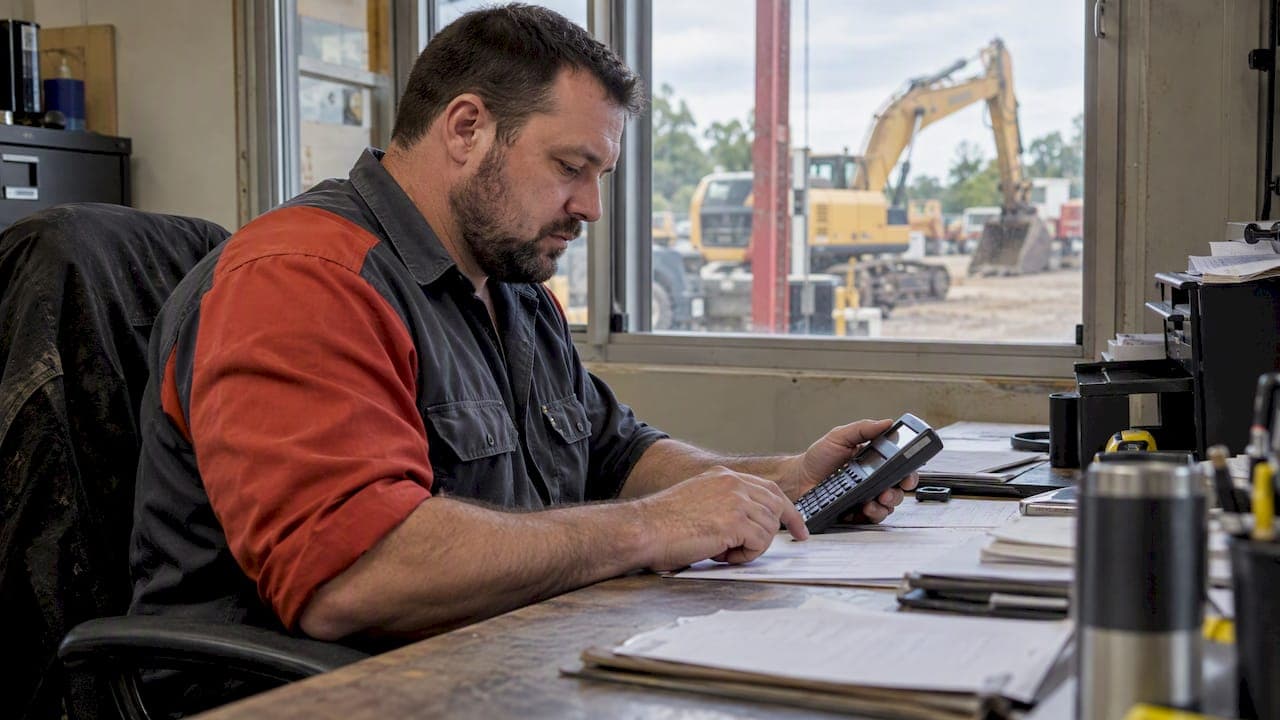
The fee on a listing page is only part of what it costs to list a piece of equipment. The full cost is the listing or advertising fee, plus the work to prepare the machine and its paperwork, plus every month the unit sits unsold, plus tax on the sale. Most sellers compare the first number and ignore the other three, and that is where money gets lost.
This guide breaks the cost into those parts. It shows how to compare classified platforms on cost per sale, not cost per ad, and which line items to budget for before you post a semi truck, an excavator or a wheel loader.
TL;DR
- Listing cost has four parts: the platform fee, preparation (photos, cleaning, service records), hold time, and tax on the sale.
- Platforms differ in model: flat classified fees, promoted placement, dealer directory inclusion, or a commission or auction fee. Compare them on expected cost per sold unit.
- Overpricing is the most expensive mistake. A machine priced above market stays listed longer, and every extra month adds to your cumulative cost.
- Have the title, specification sheet, serial number and hours ready before you post, so serious buyers do not stall.
- On Sostruckforsale, dealers and private sellers pay listing and advertising fees to post equipment. Check the current rates on the site before you budget.
Table of Contents
- The four parts of equipment listing cost
- How equipment platforms charge
- Why hold time is the hidden line item
- Preparation costs before you post
- Tax and transaction costs on the sale
- A worked example: comparing two ways to sell
- Budgeting an advertising plan for several units
- Our perspective: judge a listing by what it sells
- List your equipment with us
- Checklist before you pay for any listing
- FAQ
- Sources
The four parts of equipment listing cost
A single classified ad is simple to price. A sale is not. Think of the cost of listing as a stack.
| Cost layer | What it includes | Who controls it |
|---|---|---|
| Platform fee | Listing fee, promoted or featured placement, dealer directory inclusion | The platform, and your choice of upgrades |
| Preparation | Photos and video, washing, minor repairs, service records, inspection | You |
| Time on market | Financing, storage, insurance and depreciation while the unit is unsold | Mostly your asking price |
| Tax and transaction | Gain on sale, bill of sale, title transfer, shipping help | Your accountant and the buyer |
The platform fee is the only one printed on a rate card. The other three are real money and often larger than the fee.
How equipment platforms charge
There is no single US price for listing heavy equipment. Platforms use different models, and the cheapest ad is not always the cheapest sale.
Flat classified listing fees
You pay to post an ad, usually per unit or per package, and the buyer deals with you directly. You keep the full sale price. This suits sellers who can answer inquiries, negotiate and arrange a handover themselves. Sostruckforsale works this way: we are an online marketplace where dealers and private sellers pay listing and advertising fees to post commercial vehicles and industrial equipment.
Promoted listings
A promoted listing pays for better placement in a category, such as trucks and trailers or construction equipment. It makes sense for a unit that is in demand and priced fairly, because more views can shorten the sale. It does not fix a machine that is priced too high or photographed badly.
Dealer directory inclusion
If you move units all year, a business directory entry lets buyers find you, not only a single ad. For a dealer with ongoing inventory, this can lower the cost per unit, because one profile supports many listings.
Commission and auction fees
Auctions and consignment sales typically charge the seller a percentage instead of a posting fee. They can be fast, which is worth something. Run the math on the actual hammer price, not the headline rate. A percentage on a $120,000 machine is a very different number than a flat monthly fee.
Why hold time is the hidden line item
Every month a machine is listed, it costs you money even if the ad itself is free. You may be paying for financing, yard space, insurance and the slow loss of value. A higher listing fee that sells the unit two months sooner can be cheaper than a low fee on a unit that sits.
Price is the biggest lever. EquipmentWatch notes that sellers use transaction data to benchmark fair market value before setting a price, because listing well above current resale and auction averages leads to longer hold times and higher cumulative listing costs. Its database records marketplace, make, model, model year, location, date and price for each asset, which gives you real comparables, not guesses.
A simple way to use that principle:
- Find three to five recent sales of the same make, model, year range and similar hours.
- Adjust for condition, attachments and region.
- Set an asking price close to that range, with a small negotiating margin.
- Review the price after 30 days of listing. If inquiries are thin, the price or the photos are the problem.
For a deeper walkthrough, our guide to heavy equipment pricing with auction comps and a checklist shows how to build that comparison. EquipmentWatch also publishes values with channel-specific valuations for auction and other disposition routes, which helps when you are deciding between a classified ad and an auction.
Preparation costs before you post
Preparation is where a modest spend pays back fastest. Buyers of heavy equipment are professionals. They look for proof the machine was maintained and for reasons to walk away.
Photos and video
A phone is enough, but the shots must be complete: all four sides, the cab interior, the hour meter, the serial plate, the undercarriage or tires, and any wear or damage. For excavators we recommend 15 to 20 photos and a short walkaround video, as laid out in our guide on how to sell an excavator fast. A full wash before photos costs little and changes how the machine looks on screen.
Service records and minor repairs
Fix the cheap items: leaking hoses, missing guards, cracked lights, worn bucket teeth if the replacement costs less than the discount a buyer would ask for. Gather maintenance logs, oil analysis reports and repair invoices. A binder of records often supports a higher price than the same machine without one.
Documents
Serious buyers will ask for paperwork early. Typical items are the title or certificate of ownership, a specification sheet listing make, model, serial number and operating hours, and a bill of sale. A bill of sale is the document in which the parties to an equipment sale record the terms of the transaction. If there is a lien, resolve it with the lender before you list, not after you have a buyer.
For heavy trucks and trailers, check federal highway use tax status too. The IRS explains in its Form 2290 instructions how a trailer or semitrailer is treated as used in connection with a vehicle equipped to tow it. Ask your tax preparer whether any filing affects the unit you are selling.
Tax and transaction costs on the sale
The sale price is not your profit, and it may not be your taxable gain either. To work out gain or loss you need the property's adjusted basis. The IRS explains in Publication 544 that you must know the basis of your property to determine whether a sale produces a gain or a loss, and that basis is usually what you paid for it, with exceptions for gifts and inheritances.
Business equipment that you depreciated can create ordinary income on disposition, not only capital gain. Sales of business property are reported on Form 4797, and the instructions for Form 4797 explain which parts apply. This is a question for a CPA, who can look at your depreciation schedule and the year of sale. Do it before you set a floor price, not after the deal closes.
Add the smaller transaction items to your budget as well:
- Title transfer and registration fees, which vary by state.
- A notary or attorney if the deal is large or unusual.
- Payment handling, such as wire fees or escrow.
- Delivery. Many buyers want the seller to help arrange freight. Our guide to US heavy equipment shipping rates explains how to compare quotes so a transport cost does not collapse a deal.
A worked example: comparing two ways to sell
Take a used wheel loader you expect to sell for around $90,000. These figures are illustrative, not quotes from any platform.
| Option A: classified ad | Option B: percentage sale channel | |
|---|---|---|
| Platform cost | Flat fee for the listing period, say 3 months | Percentage of the final price |
| Your preparation | Photos, wash, records: your own time | Often lighter, the channel handles presentation |
| Time to sell | Depends on price and demand, possibly months | Often a fixed date |
| Negotiation | You deal with buyers directly | Handled by the channel |
| Typical fit | Maximize price, accept the wait | Prioritize speed, accept a lower net |
The right choice depends on what a month of delay costs you. If the unit is paid off and you can wait, a classified listing usually protects more of the price. If it carries a loan payment and yard fees, speed may justify a percentage. Our write-up on selling a wheel loader online covers how a trade-in discount, which the guide puts around 15%, compares with selling on the open market.
Budgeting an advertising plan for several units
Dealers and fleet owners should budget per unit and per quarter, not per ad. Three habits keep the cost of listing under control:
- Track inquiries per listing. If a listing gets views but no calls, the price or the photos need work. If it gets neither, the title, category or location may be wrong.
- Pay for promotion selectively. Promote the units most likely to sell quickly, the common, well-priced machines, not the specialty piece that sells to a narrow buyer anyway.
- Retire stale listings. Relist with updated photos and a revised price after 60 to 90 days, or move the unit to another channel.
If you run a contracting business and track equipment sales alongside job costs, a contractor project management app can keep budgets, estimates and receipts in one place. That makes it easier to see how much an idle machine really costs against the work it could do.
For parts, the economics differ. Low-value items do not justify promotion, so batch them, photograph the part numbers and price them clearly. See how to sell heavy equipment parts and get paid faster. Smaller machines follow a similar logic, as in our guide to selling a skid steer online.
Our perspective: judge a listing by what it sells
We run a classified marketplace for commercial and industrial equipment, so we see how sellers think about cost. The common mistake is treating the listing fee as the whole bill. A fee that looks small becomes expensive when the ad produces no qualified buyers. A fee that looks larger can be cheap when the platform puts your unit in front of people who are shopping for exactly that category.

That is why Sostruckforsale is built for industry professionals. Buyers browse by category, subcategory, price and country, so a semi truck is seen by truck buyers and an excavator by construction buyers. Dealers can register and appear in the business directory, which suits anyone who sells more than one unit a year. Private sellers can post a single machine.
Our advice is plain. Price the unit from real comparables. Put complete photos and documents behind it. Post it in the right category, with the specifications a buyer needs to decide. Review it after 30 days. A well-prepared listing at a fair price tends to cost less in total than a cheap ad that sits.
— Dave
List your equipment with us
Sostruckforsale lists construction equipment, trucks and trailers, material handling, agriculture, forestry and grounds care equipment. If you have a unit ready to sell, you can post it on Sostruckforsale as a dealer or a private seller. Check the site for current listing and advertising options, including promoted listings and the dealer directory.
Checklist before you pay for any listing
- You know the adjusted basis and have spoken to your CPA about the tax result.
- You have two or three recent comparable sales.
- Your title is clear and any lien is resolved.
- You have the serial number, hours and specification sheet.
- You have 15 or more photos and a short video.
- You know the monthly cost of holding the unit, so you know when to cut the price.
- You have a plan for delivery, whether the buyer arranges it or you do.
FAQ
How much does it cost to list heavy equipment for sale?
It depends on the platform and the model. Classified sites charge a posting or advertising fee, auctions usually take a percentage, and some channels charge for promotion on top. Ask each one for the full rate card, then compare the expected cost per sold unit, not the price of the ad alone. For Sostruckforsale, check the current options on the site.
What does the cost of listing equipment include beyond the fee?
It includes preparation such as photos, cleaning and repairs, document gathering, the carrying cost while the unit is unsold, and any tax on the gain. Delivery and title transfer can also fall on the seller, depending on the deal. These often add up to more than the posting fee.
What documents do I need to list a piece of equipment?
Have the title or certificate of ownership, a specification sheet with make, model, serial number and operating hours, and service records. A bill of sale is prepared at closing. If a lender holds a lien, get the release process settled first.
Is the money from a sale taxable?
It can be. Gain depends on your adjusted basis, and depreciated business equipment may produce ordinary income. The IRS covers this in Publication 544 and the Form 4797 instructions, but your CPA should run the numbers for your situation.
How do I keep listing costs down?
Price from real comparables, since an overpriced machine stays listed longer. Post in the correct category with complete photos and specifications. Review performance after 30 days and adjust the price or the presentation before you pay for extra promotion.
Sources
- EquipmentWatch: Market Activity
- EquipmentWatch: Values and Market Data
- IRS: Instructions for Form 2290
- IRS: Publication 544, Sales and Other Dispositions of Assets
- IRS: Instructions for Form 4797
- Practical Law: Equipment Bill of Sale