
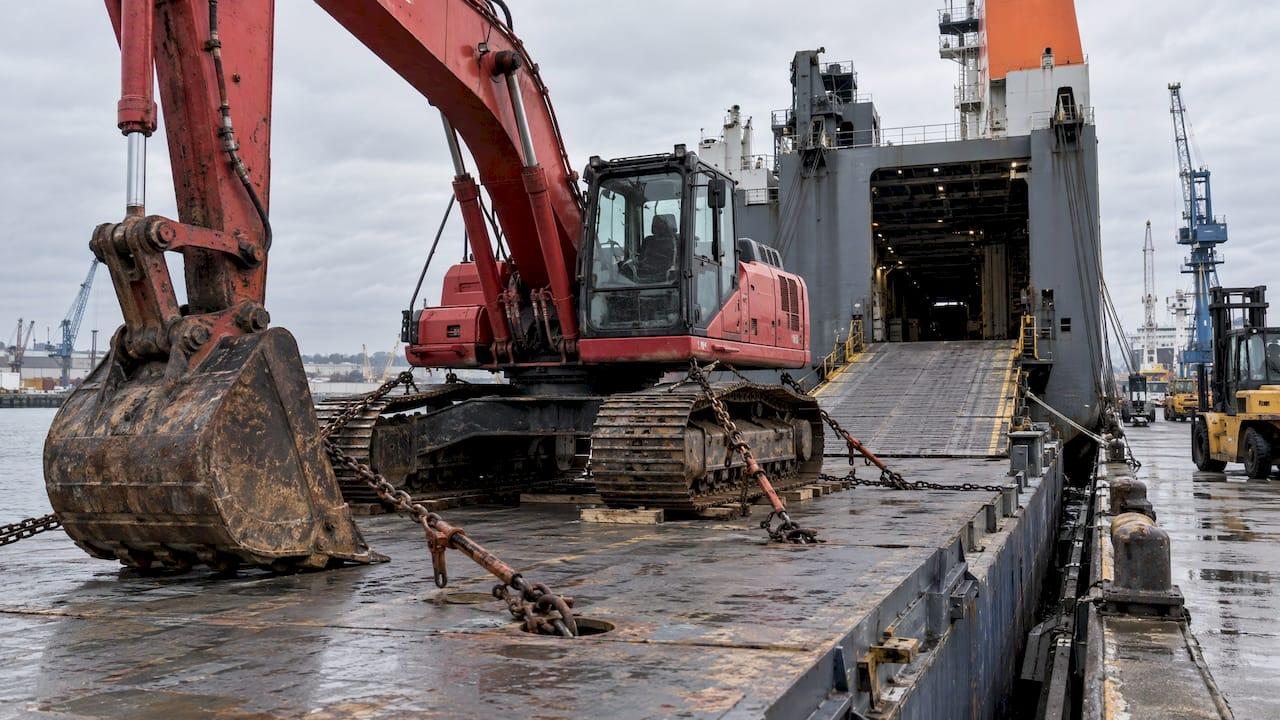
A U.S. dealer exports heavy equipment in six steps: find and vet the overseas buyer, screen the parties and classify the machine, agree price and delivery terms, secure payment, file the export paperwork, and ship. Used self-propelled machines carry a stricter deadline than general cargo: documents go to U.S. Customs and Border Protection (CBP) well before loading. This guide walks through each step in the order a sale actually moves.
TL;DR
- Vet every overseas buyer before you quote: screen the company, owners, bank and destination, and match names and bank details across all documents.
- File Electronic Export Information (EEI) through AES when the value under one Schedule B number exceeds $2,500. For used self-propelled vehicles, CBP needs the documents at least 72 hours before export.
- Price the full landed picture: freight, port charges, insurance and forwarder fees, and pick an Incoterm that states who pays and who carries risk.
- Choose a payment method that matches your risk: cash in advance, letter of credit, documentary collection or, with care, consignment.
- Keep export records for five years.
Table of Contents
- Step 1: Find overseas buyers
- Step 2: Vet the buyer and screen the deal
- Step 3: Check export controls and customs rules
- Step 4: Set price, Incoterms and payment terms
- Step 5: Prepare the export documents
- Step 6: Ship the machine
- What the sales contract should cover
- Our perspective
- List your equipment where buyers search by country
- FAQ
- Sources
Step 1: Find overseas buyers
Most export deals start the same way: a buyer abroad sees a listing, or a dealer meets a prospect at a trade show. The U.S. Commercial Service lists trade shows and its buyer-matching services, including International Partner Search, Gold Key Service and International Company Profile. These identify prospects, arrange vetted meetings and provide background on a foreign company.
Pricing for these services varies by office. The U.S. Commercial Service lists International Partner Search at $2,500 for up to five interested partners or distributors. Virtual Introductions adds to that: $3,300 with five introductions, plus $90 for each one beyond five.
Other routes that work for equipment sellers:
- Online classified listings with country filters, so buyers abroad find your machines directly.
- Embassies, trade-promotion bodies, associations and referrals from past customers.
- Agents in the destination market who already know local import rules.
Online B2B platforms generate leads, but independent trade guidance notes they call for stronger verification than a referral does.
Our own guide to closing sales with international equipment buyers covers the conversation side of this step.
Step 2: Vet the buyer and screen the deal
Vetting protects you from sanctions exposure and from payment fraud. The Maine International Trade Center suggests a practical checklist:
- Check the Consolidated Screening List, which combines export screening lists from Commerce, State and Treasury.
- Request an end-user certificate.
- Review the buyer's website and social media.
- Obtain business registration documents.
- Put license and regulatory conditions in writing.
- Hold an in-person or virtual visit with the company.
Buyer-verification guidance adds more: check the official company registry, validate the address and phone number independently, obtain trade references and credit information, screen the owners, bank and destination for sanctions, and reconcile names and bank details across the purchase order, emails and payment documents. A bank account in a third country that appears at the last minute is the classic mismatch to catch.
For domestic buyers the same discipline applies, as our commercial truck buyer screening guide shows.
Step 3: Check export controls and customs rules
Most U.S.-sourced items fall under the Export Administration Regulations (EAR). The Commercial Service advises you to classify the item as an ECCN or EAR99, then assess destination, end user and end use. Screen parties against the Consolidated Screening List. The Treasury's OFAC administers financial sanctions. The exporter is ultimately responsible for obtaining any license, and the classification and license numbers belong on the commercial invoice and the AES filing.

Meeting U.S. rules is not enough. The Commercial Service says to treat the sale as subject to both U.S. and foreign regulations and product standards. Country Commercial Guides cover tariffs, import documentation, labeling and marking, temporary or prohibited imports and customs contacts for each destination. Many countries restrict the age of imported used machinery or require emissions or safety conformity, so read the guide for the buyer's country before you quote. For importers' requirements on machinery such as backhoes and mini excavators, this contractor guide on equipment choice helps you understand how buyers compare machine types.
Step 4: Set price, Incoterms and payment terms
Build the price
The Commercial Service tells exporters to include freight, port charges, consular fees, special documentation, insurance and forwarder fees in the price, and to use Incoterms to allocate freight, insurance, duties, taxes, clearance and documentation. For inland movement to the port, see our heavy equipment shipping cost guide.
Choose the Incoterm
| Term | Seller's responsibility | Buyer's responsibility |
|---|---|---|
| FOB | Delivers the machine loaded on board at the export port | Ocean freight and insurance |
| CIF | Inland transport, export clearance, ocean freight and minimum marine cargo insurance to the destination port | Import clearance and costs after arrival |
Per one project-cargo analysis of Incoterms 2020, CIF minimum insurance is Institute Cargo Clauses C at 110% of invoice value. The same source says FCA or CIP generally suit containerized machinery better.
Choose how you get paid
EXIM's export payments guide explains the options:
- Cash in advance reduces your credit risk the most.
- Letters of credit make bank payment depend on presentation of stipulated, compliant documents.
- Documentary collections use banks to release documents against payment or an agreed date, with limited recourse.
- Consignment is often used for heavy equipment, but the foreign distributor pays only after selling the goods and may return unsold units. Our guide to used equipment consignment covers the domestic version of this arrangement.
Financing help exists. EXIM states that U.S. exporters can use export credit insurance, loan guarantees and direct loans, and cites support for a reseller exporting used bulldozers, tractors and trailers to Ghana. For eligible financing, EXIM supports the lesser of 85% of the Net Contract Price or 100% of U.S. content.
Step 5: Prepare the export documents
The common set, per the Commercial Service's export documents page, is a commercial invoice, packing list, transport document and, where required, a certificate of origin. The commercial invoice is the seller-to-buyer legal document, and customs authorities use it to set duties and check declared value.
Limco suggests that your invoice record make, model, year, serial number, hour-meter reading, condition evidence and declared value, and that the packing list show dimensions, weight and serial numbers.
EEI and AES
File EEI through AES when the value under a Schedule B number exceeds $2,500. The ITN or other filing citation must reach the carrier before loading so it can be annotated on the manifest or waybill.
Used self-propelled vehicles
Trucks, graders, loaders and similar machines get their own rule. For used self-propelled vehicles shipped by vessel or aircraft, present the vehicle and ownership documents, two complete copies, to CBP at least 72 hours before export. CBP authenticates and marks them. The EEI citation must also reach the carrier at least 72 hours before export, stricter than the 24-hour rule for general vessel cargo. Have the title, bill of sale and lien releases ready early. Our excavator ownership paperwork checklist lists what to gather.
Keep your records
The Census Bureau requires all parties to keep shipment records for five years from the export date, and agencies may demand them at any time in that period.
Step 6: Ship the machine
The Commercial Service advises you to compare carriers, costs and services, pack and label correctly, prepare accurate U.S. and foreign documents, insure against damage, loss, pilferage and delay, and consider a freight forwarder. Forwarders know foreign import rules and U.S. export regulations. They may reserve vessel space, prepare bills of lading, help with AES filing and coordinate with overseas customs brokers.
Match the method to the machine, per independent shipping guidance:
| Method | Best for |
|---|---|
| Roll-on/roll-off | Running or towable machines |
| Container | Smaller or dismantled cargo |
| Flat rack | Oversized or non-standard equipment |
Before loading, photograph every machine, record hour-meter readings and note existing damage. Our seller's checklist for shipping sold equipment goes through the handover in detail.
What the sales contract should cover
A written contract prevents most disputes. HIAB's global sales terms show the headings a machinery seller addresses: equipment specifications, price and payment, additional costs, delivery and risk, inspection, force majeure, warranty, liability and termination. For used equipment, state the condition as inspected, the hour-meter reading and whether the sale is as-is. Have an international trade attorney review the template before first use.
Sales tax is a domestic question, but it affects export pricing. See our guides on used equipment sales tax for dealers and equipment sales tax rules to confirm how your state treats exempt sales.
Our perspective
Dealers who export well treat each overseas sale as a documented transaction, not a handshake. Buyer checks, the right Incoterm and complete paperwork protect your margin more than a lower price does.
We built Sostruckforsale as a classified environment for industry professionals, with multi-category coverage and dealer registration. Listings can be browsed by category, subcategory, price and country, so a buyer abroad can find your semi truck, excavator or crane directly. Clear photos, serial numbers and hour-meter readings in the listing shorten the first conversation.
Our advice: put the specifications that customs and buyers ask about in the ad itself, so the commercial invoice later matches what the buyer saw.
Dave
List your equipment where buyers search by country
Sostruckforsale gives dealers and private sellers a place to post trucks, trailers, construction equipment, material handling machinery, agriculture, forestry and grounds care equipment. Buyers filter by country, so overseas prospects can find your machines. Register and list your equipment to start receiving inquiries.
FAQ
Do I need to file EEI for every export?
No. EEI through AES is generally required when the value under a single Schedule B number exceeds $2,500, or when another mandatory filing condition applies. Used self-propelled vehicles have their own CBP presentation rule, so confirm with a forwarder or customs broker.
Do I need a freight forwarder?
Not legally, but the Commercial Service says forwarders handle packing, space reservation, bills of lading and AES filing. For a first export of heavy machinery, most dealers use one.
Which payment method is safest for the seller?
Cash in advance reduces credit risk the most, per EXIM's payments guide. A letter of credit is the next common choice, because the bank pays against compliant documents.
How do I check whether a buyer is sanctioned?
Screen the company, its owners, its bank and the destination against the Consolidated Screening List. Keep a record of the screening with the deal file.
Sources
- Find Buyers and Partners, trade.gov
- International Partner Search, trade.gov
- Vetting Your Overseas Buyers, Maine International Trade Center
- How to Find International Buyers and Check Them
- U.S. Export Licenses: Navigating Issues and Resources
- Exporter Resources, trade.gov
- Customs Requirements and Documentation: Country Commercial Guides
- Shipping Options, trade.gov
- CIF vs FOB for Heavy Equipment
- Export Payments: 5 Ways to Get Paid for Exports, EXIM
- EXIM supports a wide range of exports
- EXIM Support Example
- Common Export Documents, trade.gov
- 19 CFR Part 192, govinfo
- 19 CFR § 192.14, Cornell LII
- FTD Trade Regulations, U.S. Census Bureau
- Exporting Construction Equipment from USA, Limco
- Hiab General Sales Terms and Conditions
- Backhoe vs Mini Excavator for Contractors