
A listing renewal policy sets how long an ad stays live, what you must do to keep it live, and what happens when it expires. Most online marketplaces use a fixed term, then either renew the ad automatically, ask you to renew it by hand, or let it lapse so you must post it again. For a dealer with excavators, semi trucks or trailers in inventory, the useful questions are simple: when does the ad expire, does renewal cost anything, and does it keep the ad's history. This guide answers each one with published rules from other types of marketplaces, then gives you a renewal routine for commercial equipment.
TL;DR
- Every marketplace sets a listing term. Published terms range from about 90 days to four months, and some run for years before inactive ads are removed.
- Renewal comes in three forms: automatic, manual, or a fresh relist that creates a new ad. Know which one your platform uses before the term ends.
- Renewing can carry a fee, and it can keep or reset the ad's history. Check both on the platform's own policy page.
- Treat every renewal as a chance to correct price, status, hours, photos and contact details, not just to click a button.
- Match the listing term to how long your unit realistically takes to sell, so you renew on purpose and not by accident.
Table of Contents
- Why marketplaces make sellers renew listings
- The three renewal models
- What published renewal policies look like
- What renewing keeps and what it resets
- Automatic or manual: which suits a dealer
- What to check every time you renew a commercial equipment listing
- Renew, edit or relist: how to choose
- Choose a listing term that fits the unit
- Our perspective
- Post and manage your equipment on SoSTruckForSale
- A renewal routine you can run every month
- FAQ
- Sources
Why marketplaces make sellers renew listings
The main reason is inventory quality. One home-goods marketplace says its renewal requirement exists to reduce the number of unavailable items on the site and to protect the reputation of all sellers. Its help center sets different terms by listing type: 60 days for one-of-a-kind and vintage items, 120 days for the rest.
The same logic applies to equipment. A buyer who calls about a 2018 tractor and learns it sold in the spring will not trust the next ad on that site. A renewal step forces a seller to confirm that the unit is still available, and that is the main thing a buyer needs from a classified ad.
There is a second benefit for you. Renewal keeps your inventory from going stale. Commentary on renewal practice notes that renewing keeps listings from stagnating and out of the view of the target audience, and that the renewal function can preserve engagement data such as views.
The three renewal models
Policies differ in detail, but nearly all fit one of three models.
Automatic renewal
The platform renews the ad when its term ends, usually charging the listing fee again if one applies. On one handmade-goods marketplace, new listings renew automatically by default, and a seller can turn that off to renew by hand. Automatic renewal protects against accidental expiry. The risk is that a sold unit can renew and bill you again if you forget to remove it.
Manual renewal
The ad expires and you act to bring it back, either by pressing a renew button or by listing it again. On one firearms marketplace, an expired listing no longer relists automatically and must be listed manually with a new expiration date. Manual renewal gives you control, and it needs a calendar reminder.
Renewal with a reminder window
Some sites email you before the end and give you a short grace period. The home-goods marketplace mentioned above sends a renewal email, gives sellers one week to renew, and sends a second email if the listing expires. If you rely on this model, make sure the account email is one somebody reads.
What published renewal policies look like
The table compares terms and costs from marketplaces of different types. None sells heavy equipment, but they show the range of choices you will meet on any classified site.
| Marketplace type | Listing term | Renewal cost and method | What it means for you |
|---|---|---|---|
| Handmade-goods marketplace | Four months | $0.20 each time a listing is created or renewed; editing is free | Edits do not trigger a fee, so update details freely |
| Firearms auction marketplace | Up to 90 days for basic auction listings | Expired listings are relisted manually | Plan around a hard 90-day ceiling |
| Home-goods marketplace | 60 or 120 days by type | Renew within one week of the email | Watch your inbox for the notice |
| Business-for-sale marketplace | 3, 6 or 12 months | Monthly rate after the term; cancel and the listing expires | A longer term suits slow-moving assets |
Two patterns matter. First, the term usually tracks how fast the typical item sells. Fast-moving consumer goods get short terms, while high-value assets that take months to move get terms measured in quarters or years. Second, fees are small per renewal on low-priced goods but become a real cost line when you carry dozens of units.
What renewing keeps and what it resets
Sellers ask this more than any other renewal question, and the answer depends on the platform.
On the handmade-goods marketplace, renewing gives a listing a new listing date and a new expiration date four months out, while keeping its original view count, favorites and web address. The web address matters for equipment, because buyers bookmark and share links to specific units.
On a large social marketplace, a company blog reports that renewing or editing a listing resets a two-year timeframe and that listings inactive for two years or more may be deleted for good. That is a long clock, but it shows that an edit can count as activity.
A relist works differently. It creates a new ad, so you lose the old view count and may lose saved questions. The relist route is also what you use when a renew button is not available. In the other direction, a platform may cap the total life of an ad. The firearms marketplace states that an unsold listing expires in up to 90 days regardless of how many times it was relisted or extended, and that optional services such as a special duration are limited to four times the listing duration.
The practical rule: read three lines of the policy before you rely on renewal. Does the ad keep its address and history? Is there a fee? Is there a cap on renewals or a maximum total life?

Automatic or manual: which suits a dealer
A dealer with a steady rotation of units often prefers automatic renewal, because missed expiry means lost leads. Some equipment-focused sites bundle auto-renewal into higher-tier packages so dealers do not update each listing by hand. The cost of that convenience is stale ads. If your inventory changes weekly, automatic renewal without a weekly status check will keep sold units live.
Manual renewal suits a smaller yard. You touch every ad on a schedule, and each touch is a chance to refresh the price and photos. A good compromise for larger inventories is to use an automated feed for the data and keep renewal under a person's control. Our guide to inventory feed setup for heavy equipment dealers covers how to map fields so that status and price changes flow into listings without retyping.

What to check every time you renew a commercial equipment listing
A renewal is a review. Before you confirm, work through this list for each unit.
- Availability. Confirm the unit is on the lot, not under deposit, not sold, not in the shop. Remove it if it is gone.
- Price. Compare against recent comparable sales and your own floor. A listing that has run a full term without serious inquiries often needs a price move, not just a new date.
- Hours, mileage and condition. Update the meter reading. An excavator that has been on a rental job for two months no longer has the hours in the ad.
- Photos. Replace old or low-light images. Follow a consistent set: exterior from four corners, cab interior, hour meter, engine bay, undercarriage or tires, and attachments. Our equipment listing template with an eight-photo checklist gives a copy-and-paste format.
- Documents. Mention available service history. Buyers weigh it heavily, and maintenance records affect resale value.
- Key fields. Check category, subcategory, year, make, model, serial number and location. Missing fields are among the most common reasons a good unit gets passed over, and our post on six listing fields dealers overlook lists them.
- Contact details. Make sure the phone number and email reach someone who will answer the same day.
- Mobile view. Open the ad on a phone. Many buyers first look at a unit from a job site or truck cab. See our guide to mobile-friendly listings.
- Tax and paperwork. If you are selling business equipment, such as a dump truck, review the tax reporting on the sale with your accountant. We cover one case in selling a dump truck online and Form 4797.
This list is general good practice for any equipment ad. It is not a rule published by any single marketplace.
Renew, edit or relist: how to choose
Use the simplest action that fixes the problem.
- Edit when only details changed, such as price, hours or a new photo. On at least one marketplace, editing carries no fee, as noted in the table above.
- Renew when the ad is accurate but its term is ending and you want it to stay live under the same address and history.
- Relist when the platform no longer offers renewal, the ad reached its cap, or the unit has changed so much that a clean start helps. One overview of renewal practice notes that when the renew button is unavailable, the seller must use Relist to create a new post.
A unit that has sat through a full term without a real inquiry is telling you something. Renewing the same ad with the same price and photos usually repeats the result. Our walkthrough on how to relist unsold semi trucks covers what to change before the second run.
Choose a listing term that fits the unit
The cleanest way to avoid renewal headaches is to pick a term that matches the sales cycle. A pickup or small skid steer can move within weeks. A specialized crane or a late-model tractor with a narrow buyer pool can take months. The business-for-sale marketplace above offers 3, 6 or 12 months for exactly this reason, and at the end of the term the listing continues at a monthly rate unless the seller cancels.
On our marketplace, sellers can review the available durations in our guide to listing duration options, which explains how to avoid a long wait between listing and renewal. Check the current options on the site when you post, because terms and fees are set there.
Our perspective
We built SoSTruckForSale for people who sell commercial and industrial equipment for a living. That shapes how we think about renewal.
A renewal is not an admin chore. It is the moment a seller confirms to every buyer that the machine is real, available and accurately described. A dealer who treats it that way builds a name for ads that are always current, and buyers return to those dealers.
Our platform covers construction equipment, trucks and trailers, material handling, agriculture, forestry and grounds care in one classified environment, with dealer registration for professionals. When a seller carries units across several categories, one place to review and renew them saves time and keeps details consistent.
Our advice is simple. Set the term to match the unit, put every expiry on a calendar, and refresh the price, hours and photos each time you renew. Do that and your ads work harder for the whole life of the listing.
Dave
Post and manage your equipment on SoSTruckForSale
If you sell excavators, semi trucks, trailers, cranes, material handling machinery, forestry or grounds care equipment, you can list on a marketplace built for industry professionals, with filters by category, subcategory, price and country. Dealers can also register for the business directory. Start from the SoSTruckForSale home page and choose the category that fits your unit.
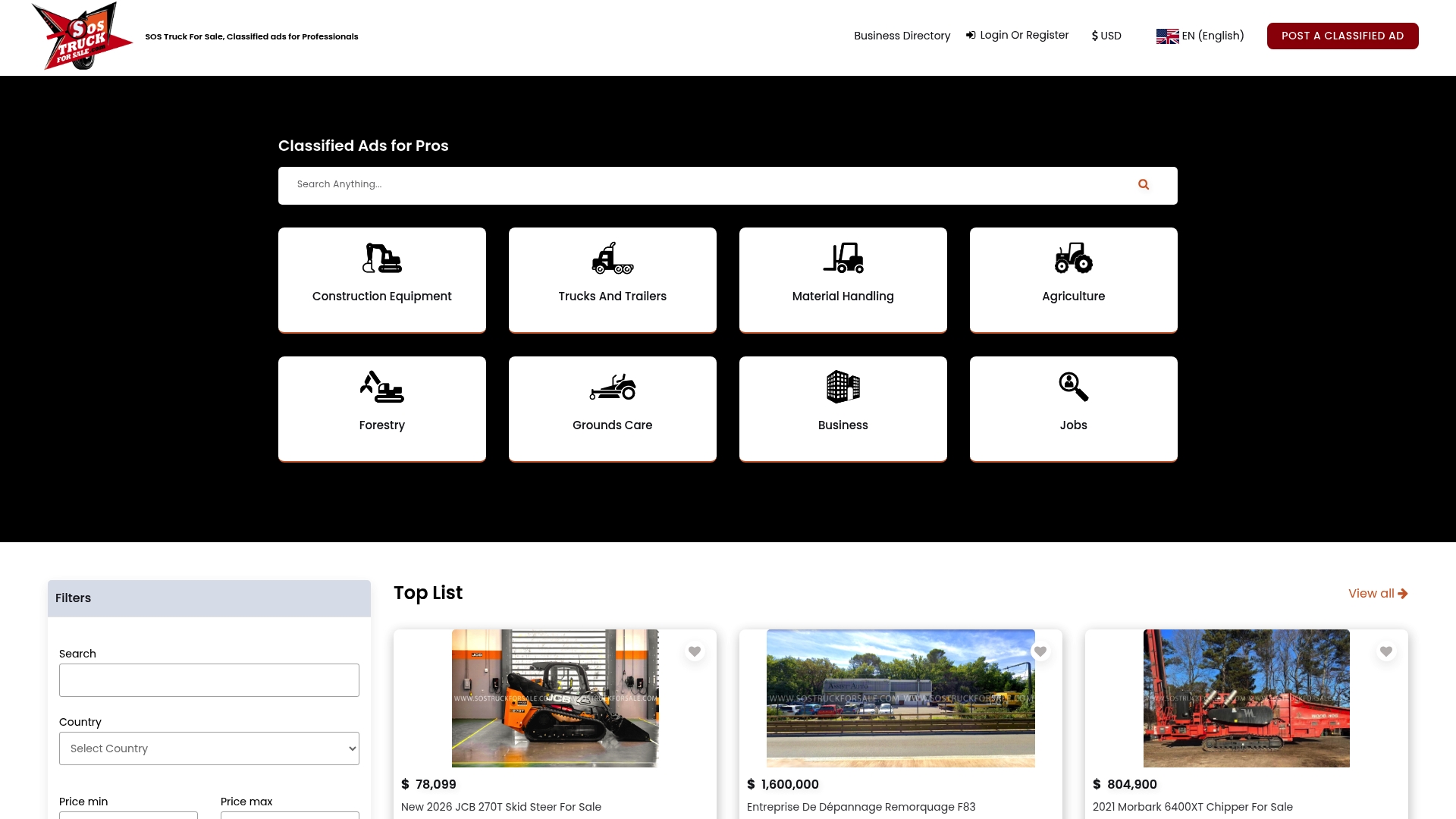
Pick your category, write the ad with the checklist above, and set your renewal reminder on the day you post.
A renewal routine you can run every month
A short routine beats a long policy memo. Here is one that works for a yard of any size.
- Week one of the month: export or list every active ad with its expiry date.
- Flag any ad expiring within 30 days. Decide for each: renew, edit and renew, or relist.
- Pull sold or committed units. Remove them the same day, not at expiry.
- Review inquiry counts. Units with views but no calls usually have a price or photo problem. Units with neither usually have a category, title or field problem.
- Refresh the weakest five ads. New lead photo, updated hours, a tighter title.
- Log the change. Note the date and what you changed, so you can judge later which edits brought leads. Our dealer playbook on getting more leads from equipment listings goes deeper on this.
If you buy as well as sell, the same discipline protects you. An ad that has been renewed many times with no change may signal a unit the market has already judged. Ask when it was last inspected and ask for the records. For fleet buyers, our overview of commercial vehicle classifieds and three costly fleet mistakes covers what to verify before you commit.
FAQ
How often do I have to renew a listing?
It depends on the platform and the listing type. Published terms include four months on a handmade-goods marketplace, up to 90 days on a firearms marketplace, and 3, 6 or 12 months on a business-for-sale site. Read the policy page on the site where you post and set a reminder for a week before the end.
Does renewing a listing cost money?
Sometimes. One handmade-goods marketplace charges $0.20 each time a listing is created or renewed, while editing is free. Other sites include renewal in the package price or charge a monthly rate. Confirm the fee on the platform's fee page before you turn on automatic renewal.
Does renewing reset the ad's views and history?
Not always. On the handmade-goods marketplace, a renewed listing keeps its view count, favorites and address. A relist creates a new ad, so the old history is gone. Check whether your platform offers a true renewal or only a relist.
Is there a limit to how many times I can renew?
Some platforms cap total life or renewal count. The firearms marketplace states that an unsold listing expires within 90 days no matter how often it was relisted or extended. When a cap applies, you start a new listing with fresh details instead.
What should I change when I renew an equipment listing?
At minimum, confirm the unit is still available and update price, hours or mileage, photos and contact details. Then check the category and key fields. A renewal with no changes repeats the result of the last term.
Sources
- Expired Listings, home-goods marketplace help center
- How to Renew a Marketplace Listing, overview of renewal practice
- How to Renew or Hide Your Listings, handmade-goods marketplace help
- Fees and Payments Policy, handmade-goods marketplace
- Listing Expiration and Relisting Options, firearms marketplace support
- Business-For-Sale Listing FAQs, business-for-sale marketplace
- Facebook Marketplace listing disappeared, company blog article