
Location filters limit equipment listings to the country, state or distance you choose, so you see machines you can realistically inspect, pick up or have hauled. Start narrow to keep freight low, then widen the area step by step when too few machines match. Check the machine's real location before you commit to any purchase.
This guide explains how location filters work on commercial equipment marketplaces, how to combine them with other filters, and what to verify when a good machine sits far from your yard.
TL;DR
- Location filters narrow results by country, and on many marketplaces by state or radius, so you control how far a machine has to travel.
- Combine location with category, subcategory and price first. Add year and hours when the list is still too long.
- If results run thin, widen the area in steps rather than removing every filter at once.
- Distance drives haul cost, and loads near 80,000 pounds can need state permits. Price the freight before you make an offer.
- Confirm the machine's actual address and see it running, in person or on a current video, before money moves.
Table of Contents
- What a location filter does
- Filters you can use on Sostruckforsale
- How to set up a location search, step by step
- Choosing a radius: near, regional or nationwide
- When the filter returns too few listings
- Count the distance in dollars before you fall for a machine
- Verify the location before money moves
- Prepare the delivery end
- For dealers: make your location work for you
- Our perspective
- Browse equipment by category and country
- FAQ
- Sources
What a location filter does
A location filter tells the search to show only listings whose seller or machine sits in the area you pick. Depending on the marketplace, that area can be a country, a state, or a radius around a ZIP code. Listings outside it drop out of the results, and the count at the top of the page changes.
For heavy equipment that matters more than it does for a used phone or a couch. A skid steer, a tandem-axle dump truck or a 30-ton excavator cannot be shipped in a box. Every mile between you and the machine adds freight cost, scheduling work and, for large units, permits. Industry marketplaces describe location filtering as a way to control shipping distance and logistics complexity, alongside filters for equipment type, manufacturer, price range, year and hours.
Three things are worth knowing before you start:
- The filter usually reads the seller's listed location. That is normally where the machine sits, but not always. A dealer with several yards may list one head office address while the unit is in another state. Ask.
- A wide area is not a bad area. A larger area means more inventory to compare, which often improves your price and your choice of year and hours.
- Location is only one filter. It works best after category and subcategory have already cut the list down to the right type of machine.
Filters you can use on Sostruckforsale
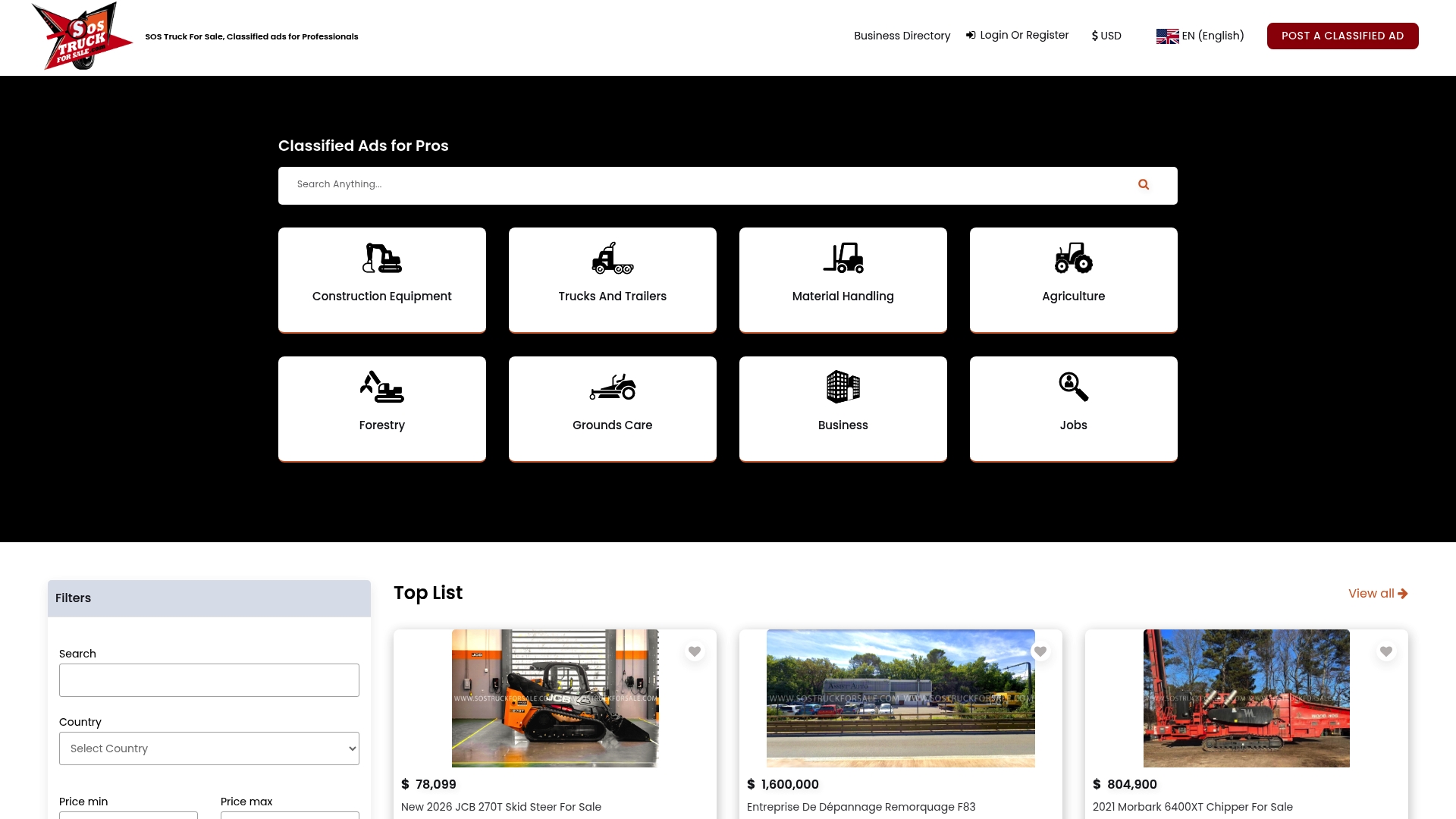
On our marketplace you can browse equipment listings by category, subcategory, price and country. The categories cover construction equipment, trucks and trailers, material handling, agriculture, forestry and grounds care. Country is the location layer, which matters for buyers who want to keep a purchase domestic and avoid import paperwork, or who want to look at machines in another country on purpose.
For anything finer than country, the listing itself is where you find the detail. Dealers and private sellers include the city or state and the contact details in the listing, so you can see where a machine sits before you call. If the location is missing or vague, ask the seller for the full yard address as your first question.

How to set up a location search, step by step
A search that works in the real world follows an order. Location should come after you know what you are buying.
- Pick the category and subcategory. Decide whether you need a wheel loader or a compact track loader, a day cab or a sleeper. If you are unsure which category fits the job, this guide to choosing the right equipment category walks through the decision.
- Set your country. For most US buyers this is the United States. It removes imports and keeps titles, emissions rules and paperwork familiar.
- Set your area. Where the marketplace offers state or radius options, begin with your own state or a short radius. If it only offers country, scan the listing locations yourself and sort mentally into near, regional and far.
- Add a price band. Set the ceiling a little above your budget. Sellers often have room to move, and a machine slightly over your limit in a nearby yard can beat a cheaper one three states away once freight is added.
- Add year and hours if available. Do this last, because it shrinks the list fastest. If you end up with only two or three machines, relax this filter before you relax location.
- Save the shortlist. Note each machine's location, the seller and the asking price in one place so you can compare delivered cost, not just sticker price.
Choosing a radius: near, regional or nationwide
There is no universal right radius. Treat it as a trade-off between convenience and selection. A tight radius lets you walk the machine, start it cold and talk to the seller face to face. A wide radius gives you more units to compare and a better chance at the exact specification.
The table below is a practical way to think about it.
| Search area | Best for | Main advantage | Main cost |
|---|---|---|---|
| Your state or a short radius | Common machines, urgent needs, buyers who want to inspect in person | Easy inspection, low freight, fast pickup | Fewer machines, less price competition |
| Neighboring states or a regional radius | Most purchases of mid-size equipment | Good balance of choice and haul cost | Some travel for inspection |
| Nationwide (country filter only) | Specialized units, rare attachments, late-model trucks | Widest selection, strongest comparison | Higher freight, permits on large loads, remote inspection |
| Another country | Buyers with import experience and a clear price gap | Possible price or spec advantages | Import duties, standards, longer lead time |
If you are buying a work truck or trailer that can be driven or towed home, a wider radius is easier to justify, because you may be able to move it under its own power. A tracked machine or a crane that needs a lowboy is a different calculation.
When the filter returns too few listings
A thin result list is common for specialized machines, and it is not a dead end. Work through these adjustments in order.
- Widen the area first. Move from your state to the region, then to the whole country. Freight is a known, quotable cost, while a missing machine has no price.
- Loosen year and hours. A machine two model years older with documented service history may fit the job and the budget just as well.
- Move up or down one subcategory. A compact excavator and a mini excavator, or a 26-foot box truck and a 24-foot one, may do the same work for you.
- Raise the price ceiling modestly. Machines just above your cap are often negotiable. Our guide to heavy equipment pricing and comparable sales helps you judge whether an asking price is reasonable.
- Check the dealer directory. A dealer in your area may have a unit that is not yet listed online, or can source one.
- Come back next week. Inventory changes daily as dealers post new units. A saved search or a weekly check catches machines the day they appear.
Online marketplaces that span many countries let a US contractor narrow results to domestic listings, or open them up to compare how regions differ in equipment preferences, standards and pricing. Use that range to compare, then decide whether the extra distance actually pays.
Count the distance in dollars before you fall for a machine
The most common mistake with location filters is treating them as a convenience feature instead of a budget tool. Every listing you open should carry a delivered price in your head: asking price plus freight plus any permit, loading and insurance costs.
Haul cost rises with three things: distance, the weight and size of the machine, and how complicated the loading is. A long cross-country haul can need relay drivers. An oversize load can add permits, escorts and routing. A machine that must be partly disassembled or lifted by crane adds labor and time. For a deeper breakdown of what to expect, read our guide to shipping heavy equipment and comparing quotes.
Two regulatory points are worth knowing for the US:
- Weight and permits. Loads approaching the federal gross vehicle weight threshold of 80,000 pounds may require a state oversize or overweight permit. Rules differ by state, so the carrier should confirm the permits along the whole route.
- Securement. The Federal Motor Carrier Safety Administration has commodity-specific cargo securement rules that include heavy vehicles, equipment and machinery. A professional carrier works to them, so confirm the carrier is familiar with your type of machine.
A lower freight quote is not always the lower total cost. Compare what each quote includes: loading equipment, permits, escorts, appointment flexibility and insurance. Ask about cargo coverage before the machine moves, because carrier liability can be limited.
A worked comparison
Imagine two comparable wheel loaders. The first is listed in your state at a slightly higher price. The second is listed two states away at a lower price. Do not decide on the sticker. Ask each seller for the yard address and loading facilities, get a freight quote for each, and add your own travel time to inspect the farther one. If the freight, permits and trip close the gap, the nearby machine wins. If a large gap remains, the distant one may be worth the effort. The filter gave you the candidates, and the arithmetic picks the winner.

Verify the location before money moves
A listing's location is a claim until you have seen the machine. Treat it that way, politely and consistently.
- Ask for the full yard address and check that it matches the seller's business details.
- Request a current walk-around video showing the machine on site, with the serial number plate, hour meter and a date marker such as the day's paper or the seller reading out today's date. Our guide to filming a machine that sells describes what a good seller video contains, so you know what to ask for.
- Inspect in person or send someone. For a major purchase, a local mechanic or independent inspector can look at a distant machine for a fee.
- Confirm the sequence of inspection, payment, pickup and delivery in writing before you pay anything.
- Be wary of shipping confusion. A machine that is always in transit, at a remote warehouse or tied up with a logistics company, and so cannot be viewed, is a reason to slow down and to confirm the pickup address independently.
If you are financing the purchase, the lender will also want the machine's location and condition. Our overview of heavy equipment financing options covers how to line up documents before you commit.
Prepare the delivery end
A far-away machine still has to arrive somewhere. Before it ships, confirm that:
- The site has room for the truck and trailer to maneuver, and the ground can take the weight.
- Someone is on site during receiving hours.
- A qualified operator or rigger is ready to unload and set the machine.
- The machine's exact configuration, including attachments and any removed parts, is written into the shipping plan, because a generic description leads to the wrong trailer and surprise charges.
For dealers: make your location work for you
If you list equipment, buyers filter you in or out by location, so accuracy pays. Put the city and state in the listing, say which yard holds the unit, and state whether you can arrange delivery. Buyers searching a wide area will favor sellers who have already answered the freight question. Use a consistent format with photos, as in our equipment listing template with an 8-photo checklist, and read our seller's checklist for shipping sold equipment safely to handle the handover cleanly. If you run a large inventory, feed setup and field mapping keeps locations consistent across every unit.
Our perspective
Buyers tell us the same thing: the machine is rarely the hard part. The hard part is knowing whether the right machine is close enough to be worth the trip.
That is why we built Sostruckforsale as a dedicated classified environment for commercial and industrial equipment. Trucks, trailers, excavators, material handling, forestry, agriculture and grounds care sit in one place, filtered by category, subcategory, price and country, so you are not digging through consumer listings to find a tractor.
Our advice is simple. Decide the machine first, set the country, then widen the area in steps until you have three or four real candidates. Compare them on delivered cost, and let the seller prove the location with an address and a current video. Dealers who state their location clearly and answer freight questions up front tend to close faster, and our dealer registration and directory are designed to put those sellers in front of buyers who are ready to act.
Dave
Browse equipment by category and country
Ready to put the filters to work? Start with the category you need, then narrow by subcategory, price and country on Sostruckforsale. You can browse construction equipment, trucks and trailers, material handling and more and contact sellers directly from each listing.
If you sell equipment, dealer registration and business directory inclusion let buyers in your region and beyond find your inventory by the same filters.
FAQ
Can I search for equipment in only my state?
Where a marketplace offers state or radius filters, yes. Choose your state or a short radius to see machines you can inspect easily. On Sostruckforsale you filter by country and then read the city and state in each listing, and you can ask the seller for the yard address.
Why does a listing show up outside the area I chose?
Sellers set their own location, and some list a head office instead of the yard holding the machine. A dealer with several sites may also show one address for all units. Ask the seller where the machine physically sits before you plan transport.
How far is too far to buy heavy equipment?
It depends on the machine, not a fixed mileage. Machines you can drive or tow home justify a wider search. Units needing a lowboy, permits or a crane make distance expensive, so price the haul before you decide. Our shipping cost guide helps you estimate it.
What should I do if my search shows only a few machines?
Widen the area first, then loosen year and hours, then try a neighboring subcategory or a slightly higher price ceiling. Check the dealer directory too, since dealers may have units on the way in.
Do I need a permit to move a machine I buy?
Not always, but large loads can. Loads near the 80,000 pound federal threshold may need state oversize or overweight permits, and the rules differ by state. Ask the carrier to confirm permits for the full route before booking.
Sources
- Using Online Marketplaces To Access A Worldwide Used Equipment Inventory
- Buying Used Machinery? What to Check Before Transport
- Cargo Securement Rules, FMCSA