
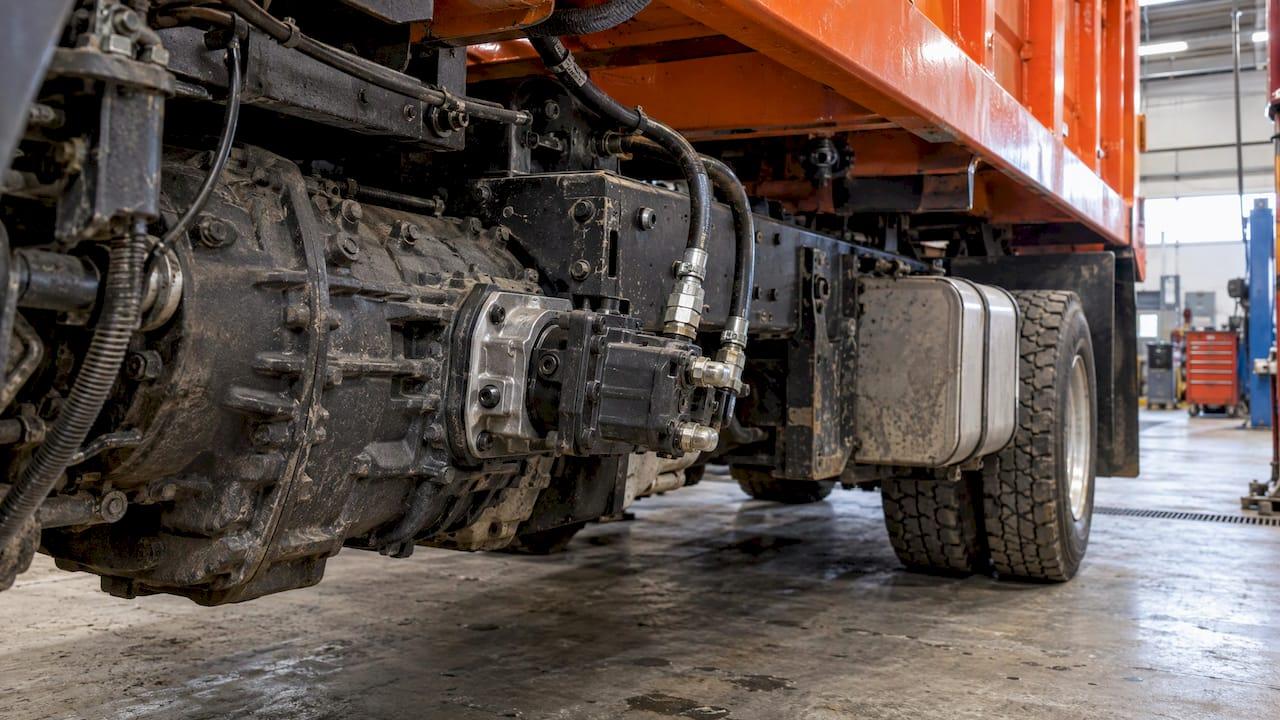
A PTO, short for power take-off, is a gearbox that lets a truck's engine run equipment other than the wheels. It bolts to the transmission (or sits at the engine or driveline), picks up rotating power, and sends it to a hydraulic pump, generator, compressor or similar unit. Muncie Power's U.S. training guide describes it as a mechanical gearbox attached to the transmission that transfers engine power to auxiliary components, most often a hydraulic pump. For a dealer, the PTO is often the reason a dump truck, crane truck or tank truck works at all. A listing that describes it precisely sells faster and draws fewer disputes.
TL;DR
- A PTO takes engine power through the transmission or drivetrain and delivers it to auxiliary equipment such as a hydraulic pump, dump hoist, crane or blower.
- Side-mount is the most common type. Others include split-shaft, top-mount, countershaft, crankshaft-driven and flywheel PTOs.
- A wrong PTO match or a wrong engagement sequence can damage the transmission and the attached equipment, and exact procedures vary by transmission.
- When you list a PTO truck, state the PTO type, the transmission, what it drives and what is installed on it.
- Pump and PTO prices depend on transmission, pump size and installation, so quote from the part and the invoice, not a rule of thumb.
Table of Contents
- What a PTO does on a truck
- Which trucks use PTOs
- PTO types and how they differ
- Operating a PTO without damaging the truck
- What dealers should put in a PTO truck listing
- What a PTO and pump cost
- Perspective
- List your PTO trucks where industry buyers look
- FAQ
- Sources
What a PTO does on a truck
A truck engine produces rotating power. Normally all of it goes through the transmission and driveline to the wheels. A PTO gives that power a second route. According to Muncie Power's guide, the engine turns the transmission gears, a PTO input gear meshes with the transmission's PTO drive gear, and that turns the PTO output shaft.
From the output shaft there are two common paths. The shaft can drive equipment mounted directly on it, such as a hydraulic pump, or it can drive equipment through a short driveshaft. Parker Hannifin's Chelsea guide describes both arrangements. With a hydraulic pump, the pump's oil flow then moves cylinders or turns hydraulic motors. That is how a dump body lifts, a crane boom extends or a roll-off hoist pulls a container.

In plain terms, the PTO lets one engine do two jobs. The truck moves the equipment to the site, then the same engine powers the work.
The parts you will see on a listing
- PTO unit: the gearbox itself, mounted to a transmission opening or other power source.
- Hydraulic pump: usually direct-mounted on the PTO. It turns rotation into oil flow.
- Controls: a cab switch, lever or air valve that engages the PTO. Some trucks add interlocks that only allow engagement under set conditions.
- Reservoir, hoses and valves: the rest of the hydraulic circuit.
- The body or tool: dump body, crane, hoist, bucket, tank pump, compressor or generator.
When a buyer asks about a PTO, they usually mean the whole chain, not only the gearbox.
Which trucks use PTOs
PTOs show up wherever a truck has work to do while parked or moving slowly. Muncie lists dump trucks, roll-off hoists, wreckers, aerial bucket trucks, tank trucks, truck-mounted cranes, generators, air compressors, pneumatic blowers, vacuum pumps and liquid-transfer pumps among typical applications (Muncie Power).
OEM body-builder documents say the same thing from the chassis side. Volvo Trucks' May 2024 Body Builder Instructions describe clutch-dependent PTOs as designed for parked work and give dump trucks, mobile cranes and tank trucks as examples. Mack Trucks' body-builder instructions list refuse bodies, dump bodies with spreaders, roll-on/roll-off and hook lifts, and municipal trucks with snow plows, cranes or dump bodies as front-PTO applications.
If you handle vocational stock, our guide to vocational truck types and uses shows where PTO-driven bodies fit among other configurations.
PTO types and how they differ
The Chelsea guide lists six main types: side-mount, split-shaft, top-mount, countershaft, crankshaft-driven and flywheel (Parker Chelsea). They differ mainly in where they take power and how they mount.
| Type | Where it takes power | Typical note |
|---|---|---|
| Side-mount | Side of the main or auxiliary transmission | The most common type |
| Split-shaft | Driveline behind the transmission | Sits in the driveline between transmission and rear axle |
| Top-mount | Top of an auxiliary transmission | Tied to that transmission design |
| Countershaft | Rear of the transmission countershaft | Depends on transmission design |
| Crankshaft-driven | Front of the engine crankshaft | The family that includes front-PTO setups |
| Flywheel | Between bellhousing and transmission | Used where engine-speed power is needed |
Side-mount is the one you will meet most. The Chelsea guide says side-mount PTOs attach to the side of the main or auxiliary transmission and calls them the most common type.
PTOs also vary by how they shift and what they output. Some engage through a clutch, some through air, some through other methods. The output may be a flange for a direct-mounted pump or a shaft for a driveshaft. Two trucks that both "have a PTO" can be very different machines, so the listing must say which.
Clutch-dependent and other engagement
Volvo's instructions describe clutch-dependent PTOs as meant for parked work. That is a design point: the way a PTO is engaged ties to the transmission, the duty and the body. A buyer who plans to work while rolling, for example spreading material, needs to know whether the truck's PTO is built for that. Do not assume.
Operating a PTO without damaging the truck
This is where listing descriptions and buyer conversations meet real risk. Muncie warns that a PTO selected or installed incorrectly can damage the transmission and the connected equipment (Muncie PTO operator's manual, 2008). Its guidance, in outline:
- Follow the manual for that specific truck and PTO.
- Match the PTO to the transmission and the load.
- Use the prescribed engagement sequence.
- For stationary operation, set the parking brake, chock the wheels, and use neutral or park as directed.
- Do not engage clutch-shift PTOs under heavy load or above 1,000 RPM.
Procedures differ by transmission. Eaton's U.S. driver instructions for its heavy-duty transmissions require the parking brake and neutral for the stationary PTO procedure they specify, and say not to proceed if the expected green stationary-mode indicator does not appear, because damage may result (Eaton Fuller driver instructions, 2007). The takeaway is that no single engagement routine is safe to assume across trucks. Selector position, brake, clutch and interlock steps depend on the transmission and PTO configuration.
Moving parts are a hazard
A rotating PTO shaft can catch clothing, hair or hands and cause injury or death, so keep clear of spinning driveshafts (Muncie operator's manual). Anyone demonstrating a truck to a buyer should shut the PTO off and stop rotation before anyone goes near the shaft.
Transmission matters
Because the PTO is fed by the transmission, buyers ask about the gearbox too. Our guides on the role of the transmission in semi trucks and automatic versus manual transmissions cover the background that helps you answer those questions.
Electronics and fault codes
Newer trucks add electronic control around PTO use. Faults on the vehicle's data network are read as diagnostic messages, and a guide to J1939 diagnostic codes explains how to decode DM1 messages and check power and termination. If a truck shows a PTO-related fault during inspection, capture that before listing and note how it was resolved.
What dealers should put in a PTO truck listing
Buyers filter by category, subcategory, price and country. Once they open a listing, the PTO details decide whether they call. A strong PTO listing answers these before the buyer has to ask:
- Transmission make and model. The PTO has to match it.
- PTO type and mounting. Side-mount, split-shaft, top-mount, countershaft, crankshaft or flywheel.
- Shift method. Clutch, air or other, as shown on the PTO.
- Output arrangement. Direct-mounted pump or driveshaft.
- Pump make and model, if fitted, and what it drives.
- Body or equipment. Dump body, crane, roll-off hoist, bucket, tank, compressor, generator.
- Controls. Cab switch, lever or air control, and any interlocks.
- Service records. Any PTO, pump or hydraulic work, with dates.
- Photos. The PTO and pump area, the cab controls and the body in operation.
Use the part numbers and plates on the equipment, not memory. If you are unsure, say what you have verified and what you have not. A precise, accurate description keeps the conversation with a serious buyer short.
Pre-sale checks
Before a PTO truck goes up for sale, run the engagement sequence from the manual for that exact transmission. Look for leaks at the pump and hoses, listen for noise at the PTO, and confirm the body responds to the controls. Our semi truck inspection checklist gives a general frame to add these items to. Always follow the manufacturer's procedure rather than a generic one.
What a PTO and pump cost
People search for PTO pump prices constantly, and the honest answer is that no single figure applies. Price follows the transmission the PTO must fit, the shift method, the pump's flow and pressure rating, whether it ships as a matched PTO-and-pump set, and the labor to install and plumb it. A pump sized for a dump body is a different part from one for a crane or a vacuum unit.
For listing purposes, document what was actually fitted and keep the invoice. A buyer can compare a documented PTO and pump against a replacement quote. If you are quoting a replacement to a buyer, get it from the PTO and pump supplier for that specific transmission and application, because Muncie's warning about incorrect selection applies equally to a replacement.
Perspective
A PTO is one of the first things a working buyer asks about, and it is also the detail most often left out of a listing. A dump truck that says "PTO" and nothing else leaves the buyer guessing about transmission match, pump and controls.
Our platform is built for industry professionals, with classified listings for trucks, trailers, construction equipment, material handling, agriculture, forestry and grounds care. Dealers can register and list in the category and subcategory where buyers search, and buyers can filter by price and country. That structure rewards listings with specific, complete descriptions.
Write the PTO line the way you would explain it to a buyer standing at the truck: type, transmission, what it drives, what has been serviced. Dealers who do that get more qualified inquiries and fewer wasted calls.
Dave
List your PTO trucks where industry buyers look
Sostruckforsale is a listing marketplace for commercial and industrial equipment: semi trucks, trailers, excavators, cranes, material handling machinery, construction equipment, forestry and grounds care equipment, agricultural machinery and parts. It includes classified ads and a business dealer directory, so dealers and private sellers can reach buyers who are already shopping by category. If you have dump trucks, crane trucks, tank trucks or other PTO-equipped units to move, post them on Sostruckforsale with the PTO details above.
Buyers researching these units can also read our truck telematics guide and the commercial truck dealer best practices article for the wider picture of buying and selling.
FAQ
What does PTO stand for on a truck?
PTO stands for power take-off. It is a gearbox that takes rotating power from the truck's engine through the transmission or drivetrain and delivers it to auxiliary equipment, such as a hydraulic pump, generator or compressor.
What does a PTO do on a dump truck?
On a dump truck, the PTO drives a hydraulic pump. The pump's oil flow powers the cylinders that raise the body. The same engine that moves the truck runs the hoist, so no separate motor is needed.
Can a PTO damage the transmission?
Yes, if the PTO is selected or installed incorrectly, or engaged the wrong way. Muncie warns that this can damage the transmission and attached equipment. Use the manual for that truck and PTO, and do not engage clutch-shift PTOs under heavy load or above 1,000 RPM.
What is the most common PTO type?
The side-mount PTO, which attaches to the side of the main or auxiliary transmission. Parker Hannifin's Chelsea guide calls it the most common type. Split-shaft, top-mount, countershaft, crankshaft-driven and flywheel units cover other mounting needs.
How much does a PTO pump cost?
It depends on the transmission, shift method, pump flow and pressure rating, and installation labor. Get a quote from a PTO supplier for your exact transmission and application, and keep invoices for any unit you list.
Sources
- Muncie Power Products, Power Take-Off Systems training guide
- Parker Hannifin Chelsea, Understanding PTOs (HY25-0063-B1/US)
- Volvo Trucks, Body Builder Instructions, Power Take-Off (May 2024)
- Mack Trucks, Body Builder Instructions, PTO (2023)
- Muncie Power, PTO Operator's Manual for 6-bolt and 8-bolt mount series (2008)
- Eaton Fuller heavy-duty transmission driver instructions (2007)
- J1939 Diagnostics: Decode DM1, Then Check Power and Termination